


-
 754
754 - Posted in August, 2026
Best Office Space in India for Enterprises: 2026 Leasing Guide
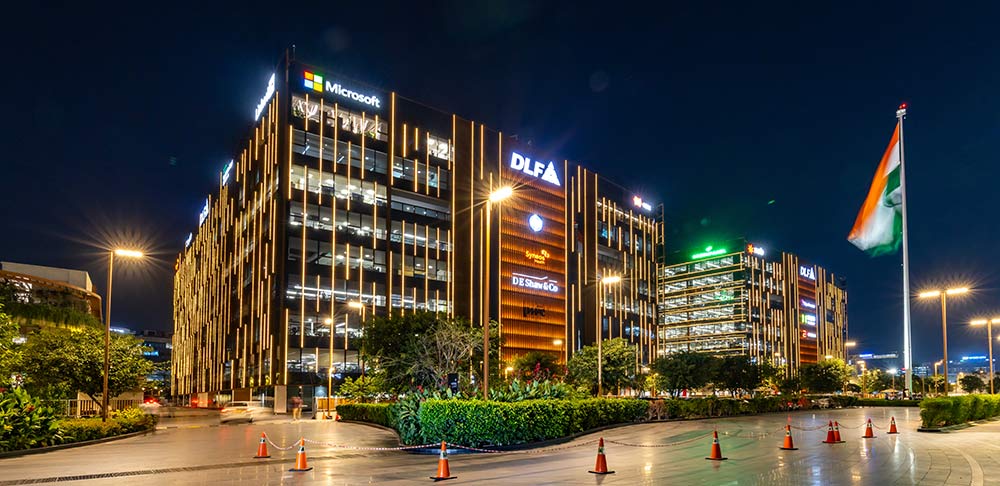
Most enterprises approach office leasing backwards. They identify a city, shortlist a few buildings, negotiate on rent, and sign. It feels methodical. But when the first renewal cycle arrives, or when headcount doubles faster than expected, or when talent starts choosing competitors with better-located offices, the gaps in that logic become expensive. The decision about office space in India was never really about square footage. It was always about positioning a business for what comes next.
In 2026, that realisation is reshaping how enterprises think about commercial real estate entirely. India's commercial property market has matured substantially, and the gap between a well-chosen office and a poorly chosen one now plays out in measurable business outcomes, not just operational inconvenience.
Why India Remains a Preferred Destination for Enterprise Office Expansion
Strong Economic and Business Growth
India's commercial real estate market absorbed over 60 million square feet of Grade A office space in 2023 alone, and the trajectory has remained consistent since. That scale reflects something real: enterprises, both multinational and domestic, are treating India not as a cost centre but as a strategic growth market. The expansion of global capability centres (GCCs) across major Indian cities has been particularly significant, with hundreds of multinationals establishing or deepening operations to access technical talent and proximity to fast-growing consumer markets.
Access to Skilled Talent Pools
Talent drives office location more than most enterprises admit publicly. When a GCC or regional headquarters is positioned in a business district with poor connectivity or limited amenity infrastructure, attrition accelerates. The best candidates have options, and they exercise them. India's major employment hubs, concentrated in Delhi NCR, Bengaluru, Hyderabad, Mumbai, Chennai, and Pune, each offer deep pools of specialised talent, but the distribution matters. A technology-focused enterprise has different priorities than a financial services firm, and office location signals cultural alignment to prospective employees long before interviews begin.
Growth of Modern Business Districts
Integrated commercial developments, built around premium infrastructure and business-district density, have fundamentally raised expectations. Enterprises occupying modern business districts benefit from the compound effects of proximity: clients, partners, service providers, and talent all gravitate toward the same zones, creating an ecosystem effect that standalone buildings cannot replicate.
What Defines Enterprise-Ready Office Space in India?
Grade A Infrastructure and Building Standards
Grade A office space in India is not simply a marketing label. It carries specific implications: seismic-compliant construction, high floor-to-ceiling ratios, efficient column grids for flexible space planning, redundant power systems, and building management that monitors mechanical, electrical, and plumbing performance in real time. Buildings carrying LEED Platinum certification and WiredScore Platinum ratings take these standards further, with measurable benchmarks for energy performance and digital connectivity. MERV-14 air filtration systems, now standard in premium developments, directly affect indoor air quality, a consideration that has moved from afterthought to procurement criterion.
Strategic Business Location
Connectivity is non-negotiable. An office that requires ninety-minute commutes erodes productivity in ways that never appear on a lease agreement but always appear in attrition figures. Enterprise-ready office space sits within reach of metro networks, expressways, and airport corridors; it is close enough to residential catchments that commuting remains tolerable and visible enough that the address itself communicates credibility.
Sustainability and ESG Considerations
ESG reporting obligations are reshaping procurement decisions across enterprise categories. Occupying a LEED-certified building with documented energy efficiency data gives enterprises measurable inputs for sustainability disclosures. The leading commercial developments now operate under frameworks like the 5'S' model, encompassing Sustainability, Safety, Social Infrastructure, Scale and Space Solutions, which provides a structured basis for evaluating a building's long-term operational credentials.
Technology-Enabled Work Environments
Smart building infrastructure is now a baseline expectation. Enterprises require high-capacity fibre connectivity, building-wide Wi-Fi architecture, smart access control, and digital visitor management. Sophisticated developments offer real-time space utilisation analytics, enabling occupiers to understand how their footprint is actually being used rather than how they assumed it would be used when signing the lease.
Key Factors Enterprises Should Evaluate Before Leasing
Scalability and Future Growth
An enterprise that signs a lease calibrated precisely to current headcount is almost always wrong within three years. Business plans shift, headcount grows, and teams that were once neatly contained in one floor inevitably require more. The right development offers the ability to expand within the same building or campus without triggering a full relocation, preserving established workplace culture and avoiding the productivity disruption that a full move invariably creates. Integrated business developments tend to offer this flexibility far more naturally than standalone buildings, where adjacent space is subject to third-party availability and competing demand.
Occupancy Costs Beyond Rent
Headline rent figures obscure total occupancy costs. Maintenance charges, parking levies, fit-out amortisation, and common-area service charges collectively determine the real cost per seat. Enterprises should model total cost of occupation across the full lease term, including anticipated escalations, rather than evaluating on base rent alone.
Business Continuity and Risk Management
Power redundancy, physical security infrastructure, and access control architecture rarely receive enough scrutiny during lease negotiations. They become critical the moment they are needed. Grade A developments with 100% power backup, advanced surveillance systems, and trained security operations provide a level of business continuity assurance that older commercial stock simply cannot match.
Understanding Commercial Leasing Options in India
Commercial Office Space for Lease vs Commercial Office Space for Rent
The distinction matters practically. Commercial office space for lease typically involves longer-term commitments, often five to nine years, with fixed terms, structured escalation clauses, and defined renewal rights. It offers stability and cost predictability suited to enterprises planning multi-year growth. Commercial office space for rent covers shorter-duration arrangements, providing flexibility but at premium pricing and with less certainty over space availability. For enterprises with established operations and predictable space requirements, leasing delivers better long-term economics.
Important Lease Terms to Review
Lock-in periods determine how long an enterprise is committed before exit provisions activate. Escalation clauses, typically ranging from 5% to 15% every three years in Indian commercial leases, compound significantly over a long term and should be modelled carefully. Renewal rights, particularly pre-emptive renewal options, provide occupiers with security over their long-term location without requiring renegotiation from scratch. Exit provisions, including subletting rights and assignment clauses, provide flexibility that becomes valuable when business conditions shift.
Best Cities for Enterprise Office Space in India
- Delhi NCR: Delhi NCR remains the dominant choice for corporate headquarters and regulated sector enterprises. The concentration of government, regulatory bodies, and institutional clients creates a business environment few other Indian cities replicate. Developed commercial corridors within the region offer some of the most mature Grade A office stock in the country, including LEED Platinum certified buildings with full enterprise-grade infrastructure.
- Bengaluru: Technology enterprises and GCCs have made Bengaluru the most internationally recognised office market in India. The depth of technical talent and the density of the innovation ecosystem continue to attract significant enterprise investment.
- Mumbai: For financial services, media, and consumer enterprises, Mumbai remains the commercial nerve centre. The financial district corridors have expanded rapidly, and Grade A supply has grown to accommodate enterprise demand that previously outpaced availability.
- Hyderabad: Hyderabad's emergence as a preferred GCC destination has been one of the defining commercial real estate stories of the past decade. Proactive urban planning and significant infrastructure investment have created business districts that compete directly with established markets on quality, while offering competitive occupancy economics.
- Chennai and Pune: Both cities have built credible enterprise office markets, with Chennai attracting manufacturing-sector headquarters and technology operations, and Pune serving as a significant base for domestic enterprises and international occupiers seeking proximity to Mumbai without the associated cost premium.
Common Mistakes Enterprises Should Avoid
Focusing narrowly on headline rental rates produces decisions that look efficient on paper and expensive in practice. Enterprises most likely to make this error are those under short-term cost pressure from central finance teams who do not experience the downstream consequences of a poorly specified office.
Underestimating future space requirements is persistently common, even among businesses with sophisticated planning functions. The headcount that signs the lease is almost never the headcount that renews it. Building in expansion optionality, even at a modest premium, is rarely regretted.
Overlooking employee experience as a leasing criterion represents a significant strategic error in a competitive talent market. Offices that employees find difficult to reach or lacking in basic amenities affect recruitment and retention in ways that carry real financial cost. Ignoring lease flexibility provisions until they are needed is the commercial real estate equivalent of not reading the insurance policy until after the incident.
Future Trends Shaping Enterprise Office Space in India in 2026
WiredScore Platinum-certified buildings represent the benchmark for digital infrastructure quality. As enterprise operations become more data-intensive, the connectivity architecture of the building itself becomes a competitive differentiator.
LEED-certified buildings with MERV-14 air filtration and documented carbon performance data are moving from premium option to standard expectation among enterprises with meaningful ESG reporting obligations. The binary choice between long-term lease and short-term rental is giving way to hybrid structures that blend committed space with flexible capacity, allowing enterprises to manage cost and footprint without sacrificing stability or adaptability.
Developments built around the 5'S' framework are increasingly preferred by enterprises that want their office environment to serve multiple organisational functions within a single coherent campus. Space utilisation analytics, occupancy sensors, and energy management platforms are transforming how enterprises understand their office performance, and the buildings that support this level of operational intelligence are already pulling ahead in enterprise procurement processes.
Why Premium Commercial Developments Matter for Enterprise Growth
There is a version of the office leasing decision that treats every square foot as interchangeable and every building as a commodity. That view tends to produce offices that function adequately and contribute nothing strategically. The enterprise experience of the past decade has largely discredited it.
Premium commercial developments, particularly those operating at Grade A specification with recognised sustainability certifications and integrated amenity ecosystems, create operational conditions that genuinely affect business performance. Employee retention improves. Client impressions strengthen. Operational disruptions are fewer. The compound effect of those advantages, sustained over a five or seven-year lease term, represents a return on location investment that rarely appears in the initial cost analysis but consistently appears in business outcomes. For enterprises competing seriously on talent, client relationships, and operational resilience, the quality of the office environment is not a secondary consideration. It is a strategic one.
Conclusion
The conversation about office space in India has moved well beyond price per square foot. Enterprises that approach leasing decisions with cost as the primary variable tend to find themselves renegotiating from a position of operational disadvantage before the lease is halfway through its term. The more durable framework evaluates location, infrastructure quality, lease structure, scalability, and total occupancy cost in combination, weighted against the specific growth trajectory and talent priorities of the business.
Grade A developments built to genuine enterprise standards, those carrying LEED Platinum certification, WiredScore Platinum ratings, and operating under comprehensive sustainability and safety frameworks, exist at the intersection of commercial performance and long-term operational confidence. That is the standard worth holding out for.
Explore DLF Offices for enterprise-ready workspaces designed for scalability, premium infrastructure, and long-term business growth.
Grade A office space in India refers to premium commercial buildings meeting the highest standards of construction quality, infrastructure, and building management. These developments typically feature seismic-compliant structures, full power backup, advanced building management systems, high-capacity digital connectivity, and sustainability certifications such as LEED or IGBC. Many Grade A buildings also carry WiredScore Platinum ratings and incorporate MERV-14 air filtration as standard.
Enterprise office leases in India typically run between five and nine years, with lock-in periods that vary by development and negotiation. Longer terms generally provide greater cost stability and allow enterprises to secure more favourable fit-out contributions and escalation caps from landlords.
Enterprises should evaluate location and connectivity, Grade A building infrastructure, scalability and expansion options, total occupancy cost beyond headline rent, lease flexibility provisions, sustainability certifications, and the operational track record of the building's management.
Delhi NCR, Bengaluru, Mumbai, Hyderabad, Chennai, and Pune are the principal enterprise office markets in India. Each serves different sector priorities: Delhi NCR for regulated industries and corporate headquarters, Bengaluru for technology and GCCs, Mumbai for financial services, and Hyderabad for operations seeking competitive occupancy economics alongside high-quality infrastructure.
Commercial office space for lease involves longer-term commitments, typically five years or more, with structured escalation, renewal rights, and exit provisions. It offers cost predictability suited to established enterprises. Commercial office space for rent covers shorter-duration arrangements that provide flexibility but at premium pricing and with less certainty over space availability.
