


-
 110
- Posted in October, 2026
Chennai Office Space for US Companies Setting Up GCC Operations
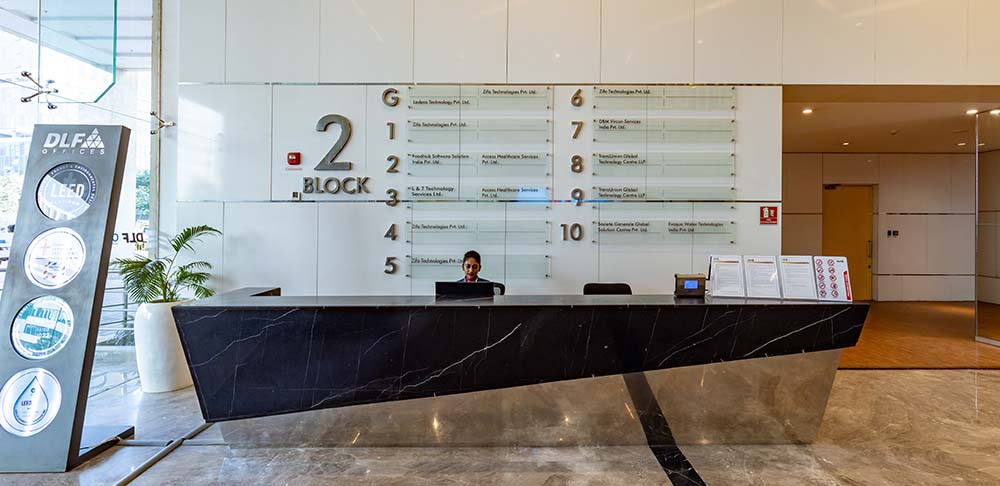
US companies establishing Chennai Office Space for US Companies face operational complexities that local Indian enterprises do not encounter. A US-based organisation setting up a Global Capability Centre must coordinate across time zones, meet multinational corporate governance requirements, maintain security protocols that match headquarters expectations, integrate Indian talent with US-based teams, and operate infrastructure reliable enough to support critical business functions. The office location and building directly determine whether these coordination challenges can be managed effectively or become operational friction that damages the GCC investment.
Most US companies approach Chennai office selection by outsourcing to local consultants or relying on recommendations from peer companies. They evaluate buildings on rent and availability without assessing whether the facility meets the specific requirements that US-based operations demand. Six months into operations, when time-zone coordination proves challenging, when client hosting becomes difficult, or when infrastructure reliability creates disruptions, the organisation discovers that the location and building were not optimally selected for US company operations.
The solution is understanding what MNC Office Space Chennai infrastructure specifically requires for effective US company integration and operation.
Time Zone Coordination and 24x7 Operations
The most significant operational difference between US company GCC operations and local Indian enterprises is time-zone dependency. A US company with a Chennai GCC must coordinate across time zones separated by 12 to 13 hours (depending on daylight saving). This separation means US business hours and Chennai business hours have minimal overlap.
This time-zone reality requires specific infrastructure:
- 24x7 Operations Capability: The facility must support continuous operations. Maintenance and security cannot follow 9 to 5 schedules. Backup power, climate control, and monitoring must operate reliably 24 hours daily.
- Night Operations Support: Chennai staff working night shifts (when the US is operating) need functional amenities: food services, security protocols, and emergency access to management.
- Distributed Team Communication: Infrastructure supporting video conferencing at any hour, secure connectivity for data transfer, and reliable power enabling 24x7 laptop and server operations.
- Client Hosting Across Time Zones: Meeting rooms and facilities must accommodate US-based client visits (who arrive with minimal notice from the US), plus local client operations.
Standard office buildings designed for 9 to 5 operations cannot accommodate these requirements. Global Capability Centre Setup Chennai for US companies must explicitly provide 24x7 infrastructure.
DLF Offices operates DLF Downtown Taramani Chennai with 24x7 infrastructure: 100% backup power capacity; MERV-14 air filtration supporting continuous occupancy; real-time building management monitoring electrical and mechanical systems 24 hours daily; trained security operations supporting all-hour building access; and a medical centre accessible for emergency support. This infrastructure is explicitly designed for 24x7 US company operations.
Security, Compliance, and Data Governance
US companies operating globally must meet security and compliance requirements that exceed standard commercial office standards. Data security, client confidentiality, regulatory compliance, and audit requirements demand infrastructure explicitly designed for enterprise security. US companies typically require the following:
- Segregated Security Zones: Confidential data and client information cannot share infrastructure with public areas or other occupants. Physical segregation is non-negotiable.
- Access Control and Monitoring: Real-time access logging, biometric entry systems, surveillance covering all work areas, and 24x7 security personnel.
- Data Centre Grade Connectivity: High-capacity, redundant internet service providers ensuring no single point of failure that could compromise operations.
- Compliance Documentation: Audit trails, service level agreements, and documented security protocols enabling regulatory compliance verification.
- Fire Suppression and Emergency Systems: Specialised systems protecting data centres and critical infrastructure (not standard commercial systems).
Corporate Office Space Chennai India serving US company requirements must exceed standard Grade A office specifications. Integrated campuses with multiple buildings, dedicated security zones, and enterprise-grade infrastructure meet these requirements. Single buildings cannot provide the infrastructure segregation and security layering that US companies demand.
Client Hosting and Business Development
US companies view the Chennai GCC as a business development asset supporting client relationships. US clients visiting the facility form impressions that affect business. The office space must communicate organisational credibility, technical capability, and professional infrastructure at levels matching US-based client expectations. This requirement shapes facility needs:
- Professional Meeting Facilities: Conference rooms with video conferencing capability, boardrooms supporting formal presentations, client meeting spaces projecting organisational credibility
- Demonstration Facilities: Space for technical demonstrations, proof-of-concept environments, product showcases
- Client Amenities: Hospitality-grade spaces for client entertainment, dining facilities supporting formal client meals, wellness facilities for client comfort
- Accessibility and Transportation: Proximity to airport, connectivity enabling direct client travel to the facility, parking supporting executive vehicle arrival
A facility designed around internal operations falls short for client-hosting requirements. US companies building client relationships through physical presence need infrastructure explicitly supporting business development.
Enterprise-Grade Technology Infrastructure
US company GCCs operate technology infrastructures serving global operations. Development environments, data processing workloads, customer-facing systems, and integration with corporate networks require robust, reliable digital infrastructure. US companies typically require the following:
- High-Capacity Fibre Connectivity: Multiple gigabit capacity, not megabit, supporting development workstations, continuous integration pipelines, and data transfer
- Redundant Internet Service Providers: No single ISP dependency. Geographic diversity ensuring local internet disruption does not disable operations.
- Building-Wide Network Infrastructure: Enterprise-grade Wi-Fi (not consumer Wi-Fi), wired connections for stationary workstations, network segregation for different security zones
- Phone and Collaboration Infrastructure: Quality voice systems, video conferencing infrastructure, unified communications supporting global team coordination
- Data Centre Power and Cooling: Dedicated power circuits for server infrastructure, specialised cooling for equipment rooms, UPS backup systems
Office Space for GCC in Chennai serving US company requirements needs WiredScore Platinum certification verifying high-capacity digital infrastructure meeting global standards. Standard commercial connectivity is insufficient.
DLF Downtown Taramani Chennai carries WiredScore Platinum certification. Phase I buildings provide documented high-capacity fibre, building-wide connectivity resilience, and digital infrastructure meeting multinational corporate standards.
Organizational Integration and US Team Coordination
US companies integrating Chennai teams with US-based teams face cultural, operational, and logistical challenges. The office facility can support or hinder this integration. Supporting integration requires the following:
- Convenient US Collaboration: Infrastructure enabling US-Chennai coordination at convenient hours (early morning for Chennai, late afternoon for US)
- Training and Onboarding: Facilities supporting new employee orientation, technical training, cultural integration
- Organisational Presence: Space for US-based team visits (quarterly business reviews, training, relationship building)
- Communication Tools: Professional meeting facilities enabling effective communication across distance
Facilities designed for local operations without US coordination infrastructure create integration friction. US companies planning to operationally integrate their Chennai team with US operations need facilities explicitly supporting this coordination.
Amenity Ecosystem Supporting Multinational Teams
US company GCCs attract employees with US-comparable expectations for workplace amenities. Indians recruited for Chennai GCC operations expect professional-grade facilities. US-based team members visiting Chennai expect comfortable, professional facilities.
DLF Downtown Taramani Chennai, provides 200,000 square feet of integrated amenities: food courts, fine dining restaurants, a medical centre, a wellness facility (Thrive, 45,000 square feet), a business centre (Guild, 30,000 square feet), a crèche, retail, a salon, and convenience stores. This amenity ecosystem supports both Indian and US-based teams operating at high occupancy scales.
The integrated amenity ecosystem is designed into a 28-acre master plan. A GCC with 500 to 1,500 employees experiences reduced daily friction (food, fitness, medical services, and retail) without leaving campus. Employee satisfaction remains high during the multi-year GCC build-up and scaling phase.
Infrastructure Scalability for GCC Growth
US companies typically plan GCC growth based on successful business development. A GCC launching at 300 people often grows to 1,000 to 1,500 within three to five years. The facility must accommodate this growth without forced relocation or operational disruption.
Integrated campuses like DLF Downtown Taramani Chennai, spanning 28 acres with 7 million square feet across Phase I and Phase II enable this growth. A GCC can occupy one tower initially, expand to adjacent towers as headcount grows, and reach mature scale without relocation. The entire operational trajectory happens within campus boundaries, preserving time-zone coordination, client relationships, and team cohesion.
Selecting Office Space for US Company GCC Success
Chennai Office Space for US Companies should be evaluated specifically for US company operational requirements: 24x7 infrastructure, enterprise-grade security, client hosting capability, high-capacity digital infrastructure, organisational integration support, amenity ecosystem supporting multinational teams, and scalability for growth without relocation.
DLF Cyber City Chennai for global companies provides this infrastructure explicitly. US companies planning GCC operations with long-term strategic intent should prioritise facilities designed around multinational corporate requirements, not optimised for local operational convenience.
An office selected based on current cost and convenience creates operational constraints within months. An office selected based on multinational operational requirements enables effective GCC operations across the strategic investment timeline.
FAQs
Time-zone overlap is limited. Chennai teams work night shifts supporting US business hours. Backup power, climate control, and security must function 24x7 for continuous operations. Standard office infrastructure supporting only daytime operation creates operational friction.
US companies handle client confidential data, proprietary technology, and regulatory compliance, requiring enterprise-grade security. Physical segregation, access control, surveillance, and audit trails exceed standard commercial office security.
Integrated campuses enable secure segregation of different functions, support 24x7 operations across multiple zones, and allow growth from 300 to 1,500 people without relocation. Single buildings cannot provide this infrastructure at scale.
Significant. US clients visiting Chennai form impressions affecting business relationships. Professional facilities, direct airport access, and quality meeting spaces support business development that virtual-only operations cannot replicate.
Partially. Security upgrades and connectivity improvements are feasible. But enterprise-scale infrastructure (24x7 operations, segregated zones, and redundant systems) typically requires purpose-built facilities, not retrofit conversions.
