


-
 301
- Posted in October, 2026
DLF Downtown Chennai: Location, Connectivity and Office Ecosystem
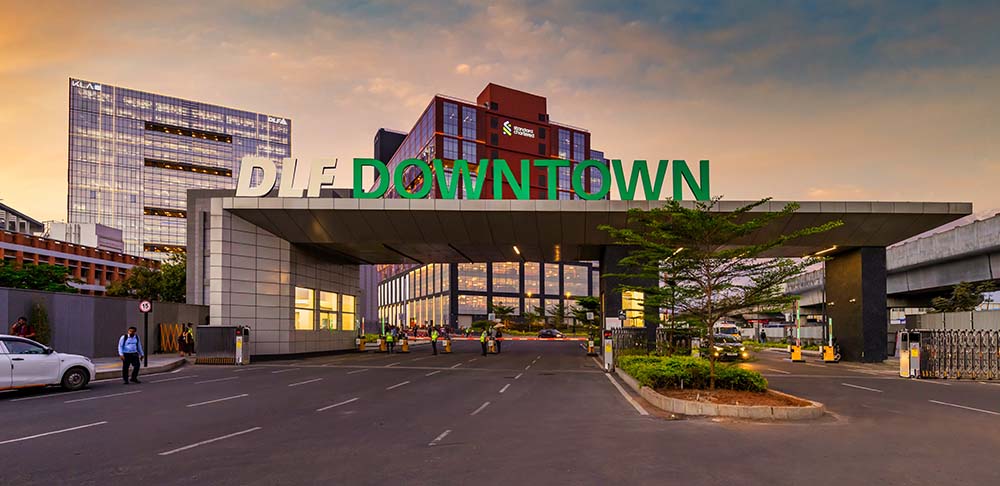
A property is valuable only when its location enables occupants to perform better. A building can have premium finishes, Grade A infrastructure, and competitive rent, yet fail because it sits in the wrong place. The occupant struggles to recruit talent, operates with persistent commute friction, and finds the location constrains rather than enables growth. Location is not simply proximity to the city centre. It is the intersection of connectivity at multiple scales: city-level access (airport, highways, and central business districts); residential access (commute distance from talent clusters); transit access (metro and bus networks); and ecosystem access (peer companies, service providers, and institutional partners). When these connectivity layers align, a location becomes strategic. When they misalign, even excellent infrastructure cannot overcome the friction.
DLF Downtown Chennai sits at this intersection. It is not simply a property in the IT corridor. It is a location where connectivity layers reinforce each other, creating an ecosystem effect that occupants recognise immediately.
Why Location Matters More Than Individual Building Specs
The commercial real estate market treats buildings as isolated assets. A developer highlights square footage, floor heights, power backup, and finishes. But occupants know better. The best occupants evaluate whether a location enables their operations at scale. A building cannot compensate for poor location through infrastructure alone. A location cannot attract premium tenants without excellent building quality. The two work together.
DLF Downtown Chennai office space functions because both dimensions align. The location enables operations. The building quality delivers infrastructure that scales. This combination is rare, and when it exists, the property commands premium positioning in the market.
Most occupants discover the importance of location only after signing a lease. A technology company thinks it needs specific floor heights and backup power, so it evaluates buildings. Only after occupancy does it realise commute accessibility shapes talent retention more than floor-to-ceiling ratios. Only when growth accelerates does it realise the development must provide expansion options without relocation. Location becomes the constraint that no building spec can overcome.
City-Level Connectivity and Enterprise Access
DLF Downtown Chennai sits at the interface of three urban systems: airport corridors, central business district connectivity, and the OMR technology corridor. This positioning provides city-level access that enables enterprise operations at multiple scales.
Airport proximity (15 kilometers, approximately 35 minutes by vehicle) enables executive mobility and client hosting. Financial services enterprises require rapid airport access for client meetings and headquarters coordination. Manufacturing headquarters need airport access for site visits and supplier meetings. Technology companies hosting client executives during project reviews need reliable airport connectivity. A location that requires 90-minute airport commutes creates operational friction that most enterprises cannot tolerate.
DLF Downtown Chennai OMR positioning provides direct access to the OMR corridor, the primary technology employment hub in Chennai. This direct access means occupants can operate efficiently without routing through congested central city traffic. Clients visiting from manufacturing facilities in suburban areas or from neighbouring cities can reach the location without navigating downtown congestion.
Central business district connectivity (15 minutes via Adyar and Guindy) enables access to corporate services (legal, accounting, banking, consulting) concentrated in downtown areas. An enterprise occupying peripheral locations requires these services to come to them at a premium cost. A location within reasonable distance of downtown service clusters reduces friction and cost.
Residential Access and Talent Positioning
The technical talent that enterprises compete for clusters in specific residential zones. Velachery emerged as the historical IT hub. The OMR corridor attracted newer talent migration. Perungudi has evolved into an emerging employment centre. DLF Downtown Taramani Chennai sits at the intersection of these three talent clusters. This positioning fundamentally shapes recruitment and retention economics:
- Velachery talent (20 minutes by MRTS or 25 minutes by road): Established technical professionals, 15+ years experience cohort
- OMR corridor residential (adjacent to employment zone): Talent already working in the area, lateral movement is minimal commute
- Perungudi proximity (25 minutes by road): Emerging professional cohort, newer residential developments
- Suburban clusters (Tambaram, Adyar: 30-40 minutes): Younger families, cost-conscious talent segments
When occupants can recruit from all three talent segments simultaneously, recruitment becomes faster and hire quality improves. Talent comparing offers weights location and accessibility heavily. A location accessible to all three segments competes on capability and growth rather than requiring compensation premiums for commute tolerance.
This accessibility is not generic. DLF Downtown in Tharamani, Chennai specifically benefits because it sits at the convergence of these talent geographies rather than favouring one over others.
Transit Infrastructure and Daily Operations
Commute accessibility is non-negotiable for technology and financial services enterprises. An office that requires 60-minute commutes from talent residential clusters faces attrition regardless of building quality. Occupants experience daily fatigue, reduced family time, and career flexibility constraints. Over a GCC lifecycle, commute friction gradually erodes retention.
DLF Downtown Chennai has dual transit advantages. Current access: MRTS Taramani Station on the operating Beach-Velachery line provides metro connectivity to Velachery (15 minutes), central Chennai (25 minutes), and surrounding areas. This existing connectivity means 60 to 70% of Chennai's technical talent can reach the location within 25 minutes using transit.
Future access: The planned Madhavaram-Sipcot metro corridor (opening projected in next 1-2 years) includes a planned metro FOB (foot over bridge) of around 300 metres (approximately a 3-minute walk) from the campus. When this metro opens, connectivity improves further. The location actually becomes more accessible, not less. This dual infrastructure positioning is strategically valuable. Most peripheral locations become less accessible when metro expansion occurs (due to construction and route changes). DLF Downtown Chennai becomes more accessible.
OMR Corridor Ecosystem and Operational Density
The OMR corridor has concentrated technical employment for 20 years, creating what economists call ecosystem effects. The zone has become self-reinforcing: talent concentrates because employment density is high, employers concentrate because talent is available, service providers concentrate because they serve both groups, academic institutions feed talent into the ecosystem, and technology conferences and events are located in the area. The DLF Downtown Chennai IT corridor sits within this ecosystem, not peripheral to it. The location provides immediate access to:
- Hundreds of technology companies operating in the OMR corridor (peer company proximity)
- Specialized training centres and certification providers
- Technology consultants and implementation partners for client delivery
- Hardware vendors and component suppliers (for product and engineering GCCs)
- Established technology conferences and professional networks
- Academic institutions (IIT Madras, engineering colleges) providing talent pipelines
- Financial services infrastructure (banks, investment firms, fintech startups)
This ecosystem density directly enables occupant operations. A GCC needs to partner with technology consultants for client delivery. The OMR corridor has these services readily available. An engineering GCC needs hardware suppliers. They are in the neighbourhood. A financial services GCC needs access to capital-market expertise. The ecosystem provides it.
Integrated Campus Infrastructure and Scalability
A single building is vulnerable. A team outgrowing one building faces relocation or renegotiation. DLF Downtown Taramani Chennai operates as a 28-acre integrated campus across multiple phases, providing infrastructure that enables occupant scaling.
Phase I consists of three buildings (DT 1, DT 2, DT 3): 3.4 million square feet, LEED Platinum certified, WiredScore Platinum rated, and 100% leased. Phase II brings four additional buildings (DT 4, DT 5, DT 6, and DT 7) under construction: 3.6 million square feet, designed for LEED Platinum and WiredScore Platinum certifications.
This scale means a GCC growing from 500 to 2,000 people can accommodate growth within the campus. Phase I tower expansion, then Phase II tower occupation, all within the same location, transit access, and ecosystem. Relocation becomes unnecessary. The development's integrated design (pedestrian concourses, shared plazas, unified amenity infrastructure) means adjacent towers function as extensions rather than separate properties.
For a team that occupies Phase I Tower 1 and grows to require Towers 2 and 3, then Phase II towers as headcount accelerates, the entire growth happens cohesively within one campus. This is a structural advantage that single buildings cannot replicate.
Amenity Ecosystem and Operational Support
DLF Downtown Chennai is not simply office towers. The 28-acre campus integrates 200,000 square feet of amenities: food courts, fine dining restaurants, a medical centre, a wellness facility (Thrive, 45,000 square feet), a business centre (Guild, 30,000 square feet), a crèche, retail, a salon, and convenience stores.
This integrated amenity ecosystem is designed into the master plan, not bolted on after construction. The implication is that amenities function coherently. A team can start the day at the gym (Thrive), grab coffee at a café, work during the day, grab lunch at multiple food options without leaving campus, attend client meetings in the Guild business centre, and pick up children from the crèche at the end of the day. The entire operational ecosystem is contained within the campus.
Occupants recognise this efficiency. It reduces daily friction, improves employee satisfaction, and simplifies logistics. This is not available in isolated buildings or single-tower developments.
Grade A Infrastructure and Operational Reliability
DLF Downtown Chennai office space delivers Grade A infrastructure across multiple certification standards:
- LEED Platinum certification (Phase I) verifying energy efficiency, water management, waste handling, and occupant health standards
- WiredScore Platinum ratings verifying high-capacity fibre connectivity, building-wide Wi-Fi resilience, and digital infrastructure meeting global standards
- 100% backup generator capacity ensuring zero downtime during grid power loss
- MERV-14 air filtration systems supporting 24x7 occupancy and health standards
- Real-time building management monitoring electrical, mechanical, and plumbing systems
- Redundant access control and security infrastructure
- Advanced emergency management protocols supporting multinational corporate standards
- On-site Bronto skylift reaching up to 24 floors, providing dedicated emergency evacuation and rescue capability: a differentiated safety asset
- 24x7 ambulance service and fully equipped medical facility supporting immediate emergency response
- Dedicated medical team and emergency protocols aligned with multinational corporate safety standards
- Integrated safety management across all 28 acres, supporting large-scale team operations without compromise
The nearby hospitals' and medical facilities' infrastructure combination means occupants operate reliably. A GCC requiring 24x7 operations across time zones needs this level of infrastructure resilience. A technology company hosting client infrastructure (data centres and development environments) needs digital infrastructure certified to global standards.
Why DLF Downtown Chennai Delivers Strategic Value
DLF Offices developed DLF Downtown Chennai with the understanding that location, connectivity, infrastructure, and ecosystem must work together. The property is not simply a collection of buildings. It is a campus where location enables operations, infrastructure scales with growth, and an ecosystem provides operational leverage that occupants cannot generate independently.
DLF Downtown Chennai Tharamani combines these dimensions intentionally. For occupants evaluating DLF Downtown Chennai office space, the value is not primarily the individual building specs (although Grade A standards are met). The value is the location at the intersection of connectivity layers, the campus integration enabling scaling, and the ecosystem providing operational advantages that isolated buildings cannot replicate.
Explore office space at DLF Downtown Chennai where location strategy, integrated campus infrastructure, and operational ecosystem combine to enable enterprise growth and operational excellence.
FAQs
Location determines commute accessibility, ecosystem access, and operational resilience. Excellent infrastructure cannot overcome poor location. Strategic location enables occupants to recruit talent, scale operations, and access services. Location and building quality must align.
DLF Downtown Chennai sits at the intersection of the OMR talent corridor, dual MRTS connectivity (current and planned), and integrated campus infrastructure. Other locations lack either connectivity layers or ecosystem density that this location provides.
Single buildings impose expansion ceilings and require relocation to scale. Integrated campuses allow growth across multiple towers within the same location, ecosystem, and amenity infrastructure without disruption or relocation.
Proximity to hundreds of technology companies, training providers, consultants, vendors, and service providers enables operations at lower cost and shorter timelines. Ecosystem density that single buildings cannot replicate.
LEED Platinum (energy, water, and waste standards), WiredScore Platinum (digital infrastructure), and documented 100% backup power verify infrastructure performance meeting enterprise and multinational standards.
