


-
 145
- Posted in October, 2026
DLF Downtown Chennai vs Other Office Spaces: What to Compare
Enterprises evaluating office locations in Chennai often fall into a familiar trap: they compare buildings instead of comparing what the buildings enable. They evaluate rent per square foot across options and select the lowest cost without accounting for commute accessibility, scalability, or total occupancy cost. They compare floor heights and power backup across properties without assessing whether the location positions the organisation for growth. They negotiate maintenance charges line item by line item without understanding how the location shapes retention and recruitment.
The comparison that matters is not between individual buildings. It is between location and ecosystems that either enable enterprise operations or constrain them. When an enterprise evaluates a comparison between DLF Offices and other commercial office spaces in Chennai, the real question is which location delivers the infrastructure, connectivity, scalability, and ecosystem that justify the investment. That requires a comparison framework that goes beyond rent and building specs. Most organisations discover too late that they used the wrong comparison framework.
Why Standard Comparison Approaches Fail
The most common approach to evaluating Chennai office spaces is cost-first: rank options by rent per square foot, select the lowest cost option, and optimise maintenance charge negotiations. This approach appears methodical and financially prudent. It ignores the variables that actually determine whether an office location succeeds or fails. A cost-first comparison overlooks the following:
- Talent accessibility and recruitment capability (location determines candidate pool)
- Commute friction and attrition patterns (poor commute accessibility erodes retention)
- Expansion options and relocation risk (single buildings force displacement when growth occurs)
- Ecosystem proximity and operational efficiency (isolated locations increase service costs)
- Infrastructure reliability during disruption (backup power and management quality matter during crises)
- Scalability and organizational growth trajectory (the lease term is 5-7 years; forecast accordingly)
- Total occupancy cost (headline rent obscures maintenance, parking, fit-out, escalations)
When enterprises compare on cost alone, they typically discover within 18-24 months that the location was poorly chosen. At that point, the lease is signed, and relocation is financially impossible. The cost savings evaporate as attrition increases, recruitment slows, and operational friction accumulates.
The Comparison Framework Enterprises Should Use
Evaluating Best Commercial Office Spaces Available for Rent in Chennai or Commercial Office Space Chennai for lease requires structured assessment:
- Location Quality: Is the location accessible to talent residential clusters? Can teams commute within reasonable timeframes? Is the address visible enough to communicate professional credibility to clients?
- Building Quality: Does the property carry third-party certifications (LEED, WiredScore, Sword of Honour)? Does it offer 100% backup power and MERV-14 filtration? Is building management documented and reliable?
- Campus Scale: Can the tenant expand within the same campus if growth accelerates? Are adjacent towers available without relocation? Does the campus have multiple buildings providing expansion flexibility?
- Amenity Ecosystem: Are on-campus services available (food, fitness, medical, and business services)? Do amenities support 24x7 operations? Do they integrate into daily workflow or require leaving campus?
- Connectivity Layers: Can employees access the location via metro or bus? Is the property accessible to city centre and airport corridors? Is future metro infrastructure accounted for?
- Cost Structure: What is total occupancy cost (headline rent plus maintenance plus parking plus fit-out)? Do maintenance charges have caps? Are escalation clauses 5% or 15%?
- Scalability Options: Can headcount growth happen within campus boundaries? Are expansion options contractually secured? What happens if the organisation needs to downsize?
- Lease Flexibility: Are renewal rights available? Can the tenant exit early if circumstances change? Are subletting provisions enabled?
This framework addresses what actually determines whether an office location works operationally and financially.
Types of Office Properties Available in Chennai Market
Chennai's office market includes distinct property types, each with different profiles:
- Single-Building Standalone Properties: Independently managed office towers. These offer the lowest headline rent but lack expansion options, create relocation risk, and operate without ecosystem effects.
- Small Integrated Campuses (2-3 buildings): Two-to-three-building developments. These provide limited expansion flexibility and smaller amenity ecosystems than larger campuses.
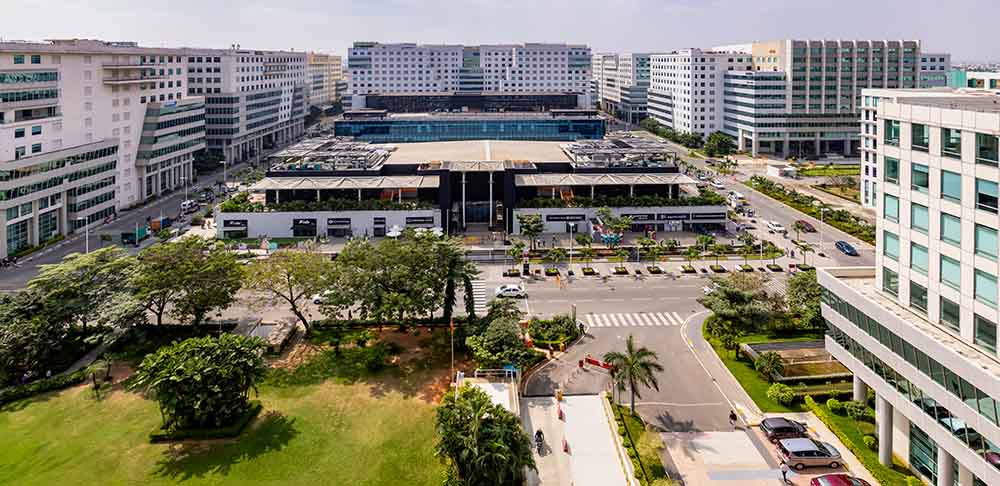
- Large Integrated Campuses (4-plus buildings): Multi-tower developments with unified master planning, integrated amenities, and meaningful expansion capacity. DLF Downtown Taramani Chennai is an example (28 acres, seven million square feet across phases).
- Ageing Commercial Stock: Buildings constructed 10+ years ago. These typically have lower rental rates but also lower infrastructure reliability, limited amenity integration, and single-building constraints.
- Retrofit or Adaptive Properties: Buildings converted from non-commercial uses. These have uncertain building management histories, potentially compromised infrastructure, and limited expansion options.
Each property type has different risk profiles and serves different enterprise needs.
Location Comparison in Chennai Market
The DLF Downtown Chennai office for Lease sits in Taramani at the intersection of three urban systems (OMR talent corridor, transit networks, and residential clusters). This positioning differs from other major Chennai office zones:
- OMR Corridor Options: Properties along OMR vary significantly. Some occupy premium locations with excellent accessibility but lack campus scale and operate as single buildings. Others sit adjacent to high-concentration talent but lack integrated amenity ecosystems.
- Outer Ring Road Properties: Locations on the Outer Ring Road offer lower costs but face commute challenges and reduced ecosystem density compared to OMR locations.
- Peripheral Technology Parks: Standalone technology parks offer the lowest rents but suffer from location isolation. Commute times to talent clusters are extended. Ecosystem access is limited.
- Central Business District Options: Properties near downtown Chennai have historical credibility but face congestion, parking constraints, and commute challenges from technology talent clusters.
DLF Downtown Chennai combines OMR location benefits (talent proximity and ecosystem access) with large campus scale (seven million square feet and expansion options) that most Chennai competitors do not offer.
Infrastructure and Certification Comparison
Commercial Office Space Chennai properties vary dramatically in infrastructure standards:
- Budget Properties: Often lack basic redundancy. Power backup (if any) covers only critical areas. Air filtration systems are standard HVAC (not MERV-14). Building management is reactive rather than real-time monitoring.
- Mid-Range Properties: Offer some infrastructure upgrades. Backup power may cover 50-75% of load. Building management is moderately disciplined. Third-party certifications (if any) are partial.
- Premium Properties: Feature Grade A+ standards. 100% backup power, MERV-14 filtration, real-time monitoring, and documented management procedures. LEED and WiredScore certifications are common.
- Leading-Edge Properties: Beyond Grade A+. LEED Platinum or LEED Zero (Water, Waste, and Energy). WiredScore Platinum. Safety certifications. Occupant health ratings (WELL). Future-proofed infrastructure.
DLF Downtown Taramani Chennai Phase I carries LEED Platinum and WiredScore Platinum certifications. Phase II targets LEED Zero certifications plus WELL ratings and Sword of Honour designation. This positions the campus above most Chennai competitors in infrastructure specification.
Scalability Comparison
Single-building properties impose expansion ceilings. When a team outgrows a 100,000-square-foot floor in a single building, options are limited: occupy vacant space elsewhere (if available), renegotiate with the landlord from weakness, or relocate entirely.
Integrated campuses with multiple towers provide expansion within campus boundaries. A team occupying one tower can expand to adjacent towers as headcount grows. This capability is rare in Chennai properties outside large integrated campuses.
DLF Downtown Chennai explicitly enables this. Phase I (three buildings, 3.4 million square feet) can accommodate expansion to Phase II (four buildings, 3.6 million square feet) as growth accelerates. A team does not face a relocation choice; it expands within the campus. Most Chennai office properties do not offer this option.
Amenity Ecosystem Comparison
Budget properties may have no on-campus amenities. Mid-range properties typically offer food outlets and basic services. Premium properties integrate 15-to-20 amenities across 100,000-plus square feet.
DLF Downtown Taramani Chennai operates 200,000 square feet of integrated amenities across 28 acres: food courts, fine dining, a medical centre, a wellness facility (Thrive, 45,000 square feet), a business centre (Guild, 30,000 square feet), a crèche, retail, a salon, and convenience services. This amenity scale is among the largest in the Chennai market.
Most single-building properties cannot replicate this ecosystem density.
Total Cost of Occupancy Comparison
Headline rent is typically 40-50% of total occupancy costs. Maintenance charges, parking, fit-out amortisation, and service charges comprise the remainder. A building with 10% lower rent but 15% higher maintenance charges is cost-disadvantaged.
DLF Downtown Chennai maintains competitive maintenance charges while offering expanded campus facilities. When enterprises model total occupancy cost across a five-to-seven-year lease (including escalations), campus properties with unified management often cost less per seat than single buildings with lower headline rent. Cost comparison requires modelling, not rent-sheet comparison.
Lease Flexibility and Long-Term Risk
Single-building properties often lack renewal rights, expansion options, or exit flexibility. The organisation is locked into the lease with no ability to adapt when circumstances change.
Integrated campus properties can structure leases with more flexibility: pre-emptive renewal rights, expansion options, and exit provisions. Landlords with multiple buildings can accommodate these requests more readily than single-building owners.
DLF Downtown Taramani Chennai offers lease structures supporting enterprise needs for flexibility and long-term adaptation.
Making Informed Comparison Decisions
Enterprises evaluating the comparison between DLF Offices and other commercial office spaces in Chennai should use structured assessment across location, infrastructure, campus scale, amenities, connectivity, total cost, scalability, and flexibility. Cost-first comparison produces decisions that look efficient initially and expensive in operation.
The offices that work are those chosen using comprehensive comparison frameworks that account for what actually determines success: location enables talent recruitment, infrastructure supports operations reliably, campus scale accommodates growth, amenities reduce daily friction, and cost structure justifies long-term investment.
DLF Downtown Chennai office space delivers across all these dimensions. Most single-building properties excel in one or two dimensions while compromising others. The comparison framework determines whether that trade-off is acceptable for your organisation's specific requirements.
Compare your requirements with DLF Downtown Chennai using structured assessment rather than cost-focused evaluation.
FAQs
Compare total occupancy cost, not headline rent. Factor in maintenance charges, parking, fit-out amortisation, and anticipated escalations across the full lease term. A 10% rent difference can disappear within maintenance charge variations.
Single buildings impose expansion ceilings. When headcount exceeds available space, options are to renegotiate (from weakness), occupy external space (at premium cost), or relocate (expensive and disruptive). Multi-building campuses enable campus-internal expansion.
LEED Platinum or LEED Zero certifications verify energy and sustainability standards. WiredScore Platinum verifies digital infrastructure. Safety certifications and occupant health ratings (WELL) verify workplace quality. Third-party certifications matter because they require independent verification.
Inaccessible locations require compensation premiums to offset commute friction. Accessible locations compete on capability and growth. Commute friction erodes retention gradually. Location determines whether an enterprise competes on talent quality or pays premium compensation.
On-campus food options, fitness facilities, medical services, and business meeting spaces reduce daily friction and employee dissatisfaction. Amenities support 24x7 operations at scale. Integrated amenity ecosystems are more valuable than scattered services.
