


-
 654
654 - Posted in September, 2026
Future of Office Space in India: GCCs, Flex, ESG and Grade A Demand
Predictions about the death of the office have a curious track record. They arrive under pressure from some disruption, accelerate briefly, and then recede as the data catches up with the narrative. What usually survives is not a return to exactly what existed before, but a recalibrated version of it, shaped by forces that were already in motion before the disruption struck.
India's commercial office market is in the middle of one of those recalibrations. What is emerging is less a debate about whether the office matters and more a sharper, more demanding conversation about what kind of office matters. The answers are visible in leasing volumes, in the investment flowing into Grade A development, and in the specific requirements that global enterprises are bringing to markets like Gurugram, Hyderabad, and Chennai.
What Is Shaping the Future of Office Space in India?
Several forces are operating simultaneously, and they reinforce rather than contradict each other. GCC expansion is driving demand for large, high-specification campuses. The maturation of flexible workspace has normalised hybrid portfolio strategies. ESG obligations have elevated sustainability from a preference to a contractual requirement. And the growing sophistication of India's commercial real estate developers has raised the quality ceiling across multiple cities.
None of these trends is new. What has changed is their convergence. An enterprise evaluating office space in India today navigates all of them at once. Organisations that handle this well find more genuinely world-class options than at any previous point. Those that treat it as a cost-minimisation exercise find that the lowest-cost options increasingly fail to meet the baselines imposed by talent markets, ESG frameworks, and technology dependencies.
The Expanding Role of GCCs
Global capability centres have become one of the defining stories of India's office market. What began as a back-office arbitrage model has evolved into something structurally different: GCCs that house product development, data science, cloud engineering, and senior leadership functions previously considered too strategically sensitive to locate outside headquarters.
This evolution has significant implications for office space requirements. Early GCC models prioritised cost and density. Current GCC models prioritise talent quality, workspace experience, and infrastructure standards capable of supporting sophisticated technology functions. The buildings required are fundamentally different from those that served the first generation.
What GCC expansion means for office demand:
- Larger contiguous floor plates are often across multiple interconnected buildings within a campus.
- Higher infrastructure specifications, including MERV-14 air filtration and WiredScore Platinum-certified connectivity.
- Greater emphasis on campus amenities that support talent retention and culture-building.
- Longer lease commitments, typically nine to fifteen years, reflecting the institutional nature of the GCC investment.
- Multi-city strategies that distribute capability across two or three Indian cities to manage talent risk and cost trajectories.
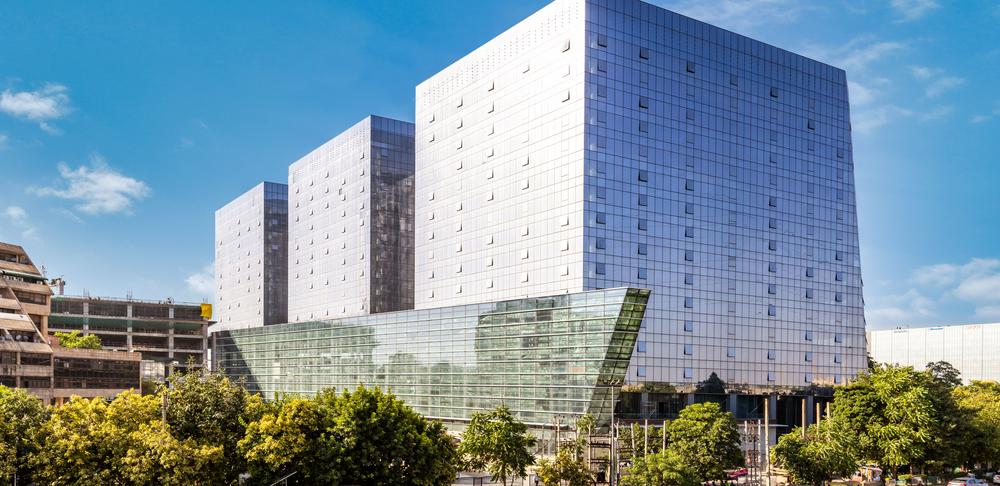
DLF Cyber City Hyderabad in Gachibowli is directly aligned with this demand profile. Hyderabad has become the most active GCC market in India by number of new centre formations, and the Gachibowli corridor provides the combination of large campus availability, state-level infrastructure support, and deep technology talent that GCC operators consistently require.
Why Grade A Offices Continue to Outperform
The bifurcation between Grade A and secondary office stock has been a consistent feature of India's commercial real estate for several years, and it is widening rather than narrowing. Enterprise occupiers, particularly those with international governance frameworks, have raised their minimum specifications to a level that older or lower-quality buildings genuinely cannot meet.
LEED certification requirements, WiredScore connectivity standards, air quality provisions, and safety infrastructure specifications have moved from differentiators to baselines for a significant share of active demand. At the same time, the supply of genuine Grade A space has grown substantially, which means well-qualified occupiers benefit from better commercial terms and greater developer flexibility.
DLF's portfolio across Gurugram illustrates the Grade A standard at its most consistent. DLF Cyber City, DLF Downtown Gurugram, Atrium Place in DLF Phase V, and DLF Cyberpark in Udyog Vihar serve different micro-market positions but share infrastructure and sustainability benchmarks that meet international enterprise requirements across all of them.
The Rise of Flexible Workspace Models
Enterprise-grade flexible workspace has matured considerably from its early coworking associations. It is now a legitimate strategic option for large organisations managing portfolio uncertainty, multi-city expansion, or workforce distribution across more locations than a direct lease strategy can cost-effectively serve.
The flexible workspace landscape currently serves several distinct use cases:
- Overflow capacity for organisations with a committed core office absorbing headcount variability.
- Market entry arrangements providing high-quality workspace quickly before a direct lease is justified.
- Satellite offices for large enterprises give employees quality workspace in cities where the primary office is not located.
- Transition arrangements between leases or during fit-out periods.
What has changed is that enterprise occupiers now expect managed workspace to match the infrastructure and amenity standards of directly leased Grade A space, rather than accepting a compromise. Developers with both managed and direct inventory in the same portfolio are well-placed to serve this expectation, since building standards remain consistent regardless of the leasing arrangement.
ESG Moves from Preference to Priority
The shift in ESG's status within office leasing decisions has been faster than most market participants anticipated. It has moved from a soft preference discussed in early-stage conversations to a hard requirement embedded in procurement and governance frameworks.
For enterprise occupiers with international parent organisations, listed status, or institutional investor oversight, the sustainability credentials of leased real estate now feed directly into annual disclosures and supply chain assessments. A building that cannot demonstrate independent environmental certification creates a gap in ESG reporting that is increasingly difficult to explain.
LEED Platinum-certified buildings represent the highest verified tier of environmental performance available in commercial real estate. The certification independently audits energy performance, water management, indoor environmental quality, and construction materials, providing occupiers with a single credential that addresses multiple disclosure requirements simultaneously.
Practical implications for leasing strategy:
- Buildings without credible sustainability certification are being systematically excluded from shortlists by international enterprise occupiers, regardless of other attributes.
- LEED Gold or Platinum has become a standard requirement in many formal RFP processes for large office space.
- Developer ESG commitments, including net-zero targets and published sustainability reports, are being evaluated as part of the landlord qualification process.
Business Parks as Future Workplace Hubs
The integrated business park campus is emerging as the preferred physical format for enterprise office occupancy in India's major commercial cities. The reasons are both operational and cultural.
Operationally, a well-designed campus provides expansion optionality that standalone buildings cannot match. An occupier entering at 50,000 sq ft and growing to 3,00,000 sq ft over seven years maintains address continuity, retains its workforce's commute patterns, and avoids relocation costs. The campus absorbs the growth in ways that a single floor within a multi-tenant tower never could.
Culturally, campus environments create a quality of daily experience that isolated offices struggle to replicate. Investment in food and beverage variety, fitness infrastructure, social gathering spaces, and transit connectivity creates a working environment that supports the culture-building role that enterprise offices need to perform in hybrid working models, where voluntary attendance becomes a meaningful metric.
DLF's 5S framework is operationalised most completely within the campus format. Assets like DLF Cyber City Gurugram and DLF Cyber City Hyderabad function as integrated commercial ecosystems, providing a density of amenities and infrastructure that individual developments cannot achieve.
Smart Buildings and Digital Workplaces
The distinction between a smart building and one that merely claims to be smart has become more consequential as enterprise technology dependencies have deepened. For organisations running large technology teams, the building's digital infrastructure is foundational to daily operations.
WiredScore Platinum-certified buildings provide the independently verified standard that enterprise technology teams can cite in internal procurement justifications. The certification confirms active connectivity from multiple providers, passive infrastructure quality, mobile signal coverage across all zones, and resilience provisions for connectivity continuity.
Smart building capabilities that are increasingly expected:
- Integrated building management systems with real-time occupancy, energy, and environmental monitoring.
- App-based access, room booking, and facilities reporting for every building occupant.
- Predictive maintenance that reduces HVAC and mechanical downtime before it affects occupied floors.
- Energy management automation that reduces consumption based on occupancy without manual intervention.
- Open API architecture allows building data to integrate with the occupier's own workplace analytics platforms.
Key Cities Driving Future Office Demand
The geography of enterprise office demand in India has diversified, though concentration in a handful of cities remains the structural reality. Gurugram continues to attract senior leadership functions and professional services operations with strong North India talent needs. Hyderabad's GCC cluster has deepened to the point where peer learning and shared vendor relationships now create additional reasons to locate there beyond cost and talent availability alone.
Chennai's combination of engineering talent depth, lower attrition rates than most comparable cities, and competitive leasing economics makes it the consistent choice for operations prioritising long-term workforce stability. DLF Downtown Chennai in Tharamani and DLF Cyber City Chennai in Manapakkam serve two distinct commercial nodes within Chennai's established IT corridor.
Noida has strengthened its position for IT and financial services operations seeking proximity to Delhi with better space economics. DLF Techpark Noida provides Grade A options within that corridor. Chandigarh, through DLF Techpark Chandigarh, serves organisations building in north Indian talent markets outside the primary metro catchment areas.
What Occupiers Will Prioritise by 2030
The trajectory of enterprise office requirements over the next several years points consistently toward fewer, higher-quality commitments. Portfolio rationalisation, quality upgrading, and consolidation of multiple dispersed locations into single integrated campuses are already visible trends in large-enterprise leasing behaviour.
By 2030, the priorities visible in leading-edge leasing decisions today are likely to be market-standard expectations:
- LEED Platinum certification is a standard requirement rather than a premium differentiator.
- WiredScore Platinum connectivity verification as a baseline enterprise criterion.
- Net-zero or near-zero carbon buildings are featured as mandatory criteria in ESG-aligned leasing frameworks.
- AI-driven building management systems that actively optimise performance rather than passively monitoring it.
- Campus social infrastructure is designed around workforce health, connection, and sustained voluntary attendance.
Why Future-Ready Offices Will Define Business Success
The case for treating office space as a strategic asset rather than an operational cost rests on a straightforward observation: organisations that attract the best talent, retain them at scale, and build the cultures required for sustained performance tend to be the ones whose workplaces make those outcomes easier rather than harder.
That is not a guarantee. An exceptional workspace does not substitute for leadership, product, or strategy. But it is an enabler, and in competitive talent markets, the quality of the physical environment is a more consequential variable than it was when office attendance was simply assumed.
What is worth noting, as India's commercial office market continues to mature, is that the question of whether to invest in high-quality, future-ready workspace is becoming less about philosophy and more about arithmetic. The cost of attracting and replacing talent in a below-standard environment, accumulated over a lease term, consistently exceeds the premium attached to the environment that would have prevented the problem.
Explore future-ready workspaces with DLF Offices across India's most active commercial markets.
FAQs
GCCs are expanding beyond back-office functions into product development and senior leadership roles, requiring larger Grade A campuses with LEED-certified buildings, WiredScore Platinum connectivity, and strong talent ecosystems across Hyderabad, Gurugram, and Chennai.
ESG has moved from preference to governance requirement. LEED Platinum certification, MERV-14 air quality standards, and renewable energy provisions are now evaluated as mandatory procurement criteria in many large enterprise leasing processes, not optional enhancements.
WiredScore independently verifies fibre connectivity diversity, passive cabling quality, mobile coverage, and resilience provisions. WiredScore Platinum confirms the highest digital readiness tier, providing enterprises with audited assurance rather than unverified developer claims.
Gurugram, Hyderabad, and Chennai are positioned for sustained enterprise and GCC demand. Noida and Chandigarh are growing secondary markets, with DLF Techpark assets serving organisations building presence outside primary metro catchment areas.
Enterprises are combining committed core leases with managed flexible workspace for overflow, market entry, and satellite functions. This hybrid approach reduces risk during headcount uncertainty while maintaining the infrastructure and experience standards that enterprise operations require.
