


-
 617
617 - Posted in September, 2026
Gurugram vs Chennai vs Hyderabad: Which City Is Best for Office Space in India?
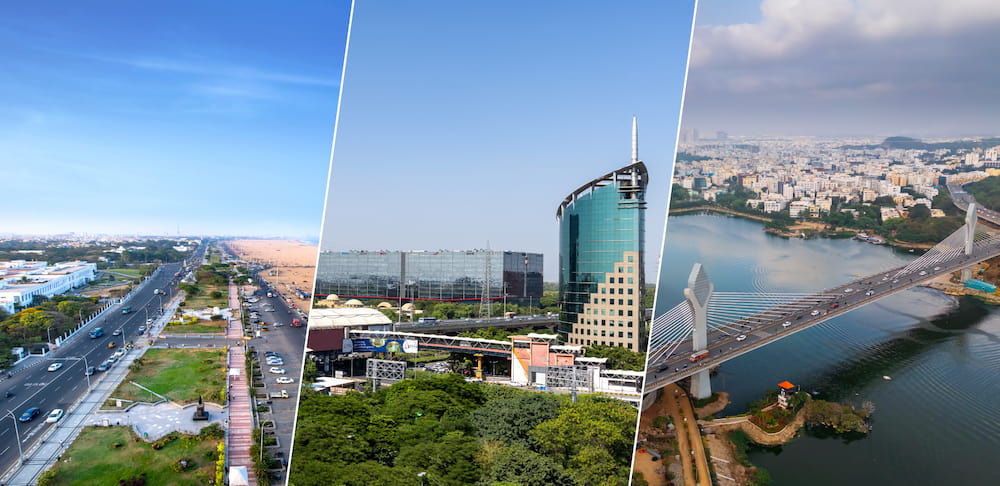
Ask ten real estate advisors which is the best city for office space in India, and you will get ten different answers. Not because the question is vague, but because the answer depends on something most city comparisons refuse to acknowledge: what kind of business you are, what kind of talent you need, and how quickly you plan to scale.
Gurugram, Chennai, and Hyderabad each carry genuine momentum right now. Each has drawn significant enterprise attention, attracted global capability centres, and matured its commercial real estate stock in ways that were not possible a decade ago. But they are not interchangeable. The assumptions that push one organisation toward Gachibowli might be the very reasons another chooses Manapakkam or Taramani. This comparison works through the distinctions that actually matter. Let's dive into the very reason that sets these locations apart.
Why Location Matters More Than It Did Before
Office location decisions have become more strategic, not less, even as hybrid working has reshaped how space gets used. For global teams setting up India operations, the choice of city affects talent availability, lease economics, infrastructure reliability, and proximity to an existing industry cluster. Get it right, and the location itself becomes an operational advantage. Get it wrong and the friction compounds quickly.
The question is not which city is universally better. It is the city that fits a specific business profile.
- Enterprise functions demanding deep engineering and product talent weigh city choices differently than BPO-heavy operations.
- GCCs building long-term capability need to assess university output, attrition patterns, and cost trajectories over five to ten years, not just current Grade A availability.
- Businesses sensitive to talent mobility look closely at how well a city retains professionals, not just how many it produces.
Gurugram: The Enterprise Nerve Centre of North India
Gurugram occupies a position that no other Indian city has replicated in the north. Proximity to Delhi, direct connectivity through Indira Gandhi International Airport, and decades of enterprise clustering have produced a commercial ecosystem that operates at a genuinely global standard.
The city draws heavily from IITs, IIMs, Delhi University, and a broad network of north Indian institutions. Senior leadership talent, in particular, tends to be more concentrated here than in any southern metro. For businesses that need C-suite proximity, consulting hubs, or finance and legal functions near decision-making corridors, Gurugram carries distinct structural advantages.
DLF's footprint in Gurugram reflects this positioning clearly. DLF Cyber City in Cyber City remains one of India's most recognised commercial addresses, hosting multinational occupiers across technology, financial services, and professional consulting. DLF Downtown Gurugram brings contemporary Grade A workspace to a corridor that continues to attract enterprise mandates. Atrium Place in DLF Phase V serves occupiers seeking a quieter, more contained campus environment, while DLF Cyberpark in Udyog Vihar offers large-format space for operations requiring significant floor plates.
Key Characteristics of Gurugram as an Office Destination:
- Strong concentration of senior and mid-management talent pools.
- Established financial services, consulting, and technology ecosystem.
- Superior international connectivity via Delhi airport.
- Premium Grade A stock with LEED-certified buildings and WiredScore Platinum-certified infrastructure available.
- Higher lease rates in core areas, though negotiable across different micro-markets.
Chennai: The Underestimated Contender
Chennai tends to be underestimated in city comparisons, and that underestimation often works in favour of occupiers who do their homework. The city has consistently built engineering depth without the cost inflation that comes with hype cycles. Attrition rates are among the lowest of any major Indian tech city, a fact that matters significantly to businesses building long-term capability.
The manufacturing and engineering heritage of Tamil Nadu feeds directly into the kind of talent profile that suits automotive technology, industrial software, and embedded systems work. Chennai is also home to a large and active financial services back-office sector, and its port connectivity gives it a specific relevance to supply chain and logistics operations.
DLF operates two significant assets in the city. DLF Downtown in Tharamani sits within one of Chennai's most established IT corridors, benefiting from proximity to the Old Mahabalipuram Road ecosystem. DLF Cyber City in Manapakkam extends that reach westward, offering occupiers access to a growing commercial precinct with a strong residential catchment nearby.
What Makes Chennai Worth Serious Consideration:
- Lower attrition rates compared to Bengaluru and Hyderabad.
- Strong engineering and manufacturing-adjacent talent pipeline.
- Competitive leasing costs relative to workspace quality.
- LEED-certified buildings with sustainability credentials suited to ESG-conscious occupiers.
- Established presence of global automotive, technology, and financial services firms.
Hyderabad: The GCC Capital in the Making
Hyderabad's rise over the past eight years has been real, not manufactured. The combination of proactive state policy, large land parcels, planned infrastructure, and a growing university ecosystem has made it the default shortlist entry for many global capability centres entering or expanding in India.
Gachibowli and the Financial District have emerged as the anchor zones for enterprise office space, with road connectivity improving steadily and the metro network extending its reach. The talent pool skews toward engineering and technology, with particular depth in cloud infrastructure, data analytics, and product development.
DLF Cyber City in Gachibowli sits at the heart of this activity. The project reflects DLF's broader commitment to what it describes as the 5S framework: Sustainability, Safety, Social Infrastructure, Scale, and Space Solutions. For GCCs requiring large campuses with integrated amenities, MERV-14 air filtration, and LEED Platinum Certified building standards, Hyderabad offers a combination of quality and scale that is difficult to replicate at comparable cost elsewhere.
Why Hyderabad Stands Out for Enterprise and GCC Leasing
- Highly competitive lease rates with significant headroom for large-format occupation.
- Strong state support for commercial real estate and infrastructure development.
- Growing engineering talent base with particular strength in technology functions.
- Large contiguous floor plates suited to GCC buildouts.
- LEED Platinum-certified and WiredScore Platinum-certified assets are available through developers like DLF.
Comparing Talent Availability
Talent is where city comparisons get genuinely complicated, because depth varies by function rather than by city alone.
Gurugram leads for senior leadership, finance, legal, and consulting profiles. Chennai leads for engineering stability, low attrition, and manufacturing-adjacent technical skills. Hyderabad leads for scalable technology hiring and cloud-native talent at mid-to-senior levels.
For a GCC building a 500-person engineering centre, Hyderabad's talent pipeline and cost structure make it the most logical starting point. For an organisation establishing a regional headquarters with cross-functional leadership, Gurugram's ecosystem is difficult to bypass. For businesses prioritising retention and long-term workforce stability, Chennai's track record deserves serious weight.
Comparing Business Ecosystems
Ecosystem maturity affects everything from vendor availability to peer hiring to event and networking infrastructure.
- Gurugram has the most developed professional services ecosystem outside Mumbai, with deep networks in finance, consulting, and technology.
- Hyderabad has built a notable GCC cluster, meaning that businesses entering the city benefit from shared knowledge, vendor familiarity, and a growing community of GCC-focused professionals.
- Chennai's ecosystem is quieter but sturdier: less hype, more operational reliability.
Comparing Connectivity and Infrastructure
All three cities have international airport connectivity, though the scale and frequency of routes vary. Delhi airport serves Gurugram and offers the widest international network. Hyderabad's Rajiv Gandhi International Airport has expanded its global reach substantially. Chennai's airport handles significant international traffic, particularly within the Asia-Pacific corridor.
Road infrastructure within city limits differs more sharply. Gurugram's internal connectivity can be strained during peak hours. Hyderabad's planned road grid around Gachibowli provides better large-scale accessibility. Chennai's arterial road network is well-established, though the city's coastal geography creates some zoning constraints.
Comparing Office Space Options and Grade A Supply
The Grade A office market across all three cities has matured, but the composition differs.
Gurugram offers the widest range of premium addresses, from flagship campuses in Cyber City to boutique commercial assets in Phase V and Udyog Vihar. Chennai's supply is concentrated along the OMR and the Manapakkam corridor. Hyderabad's supply is the largest in absolute terms among the three, with significant inventory in Gachibowli, Kondapur, and the Financial District.
For occupiers seeking LEED-certified buildings with MERV-14 air filtration and modern workplace standards, all three cities now have credible options. DLF's projects across Gurugram, Chennai, and Hyderabad share consistent sustainability and infrastructure benchmarks, which simplifies due diligence for multi-city operators.
Comparing Costs and Long-Term Value
Lease rates tell only part of the cost story. Fit-out economics, power reliability, operating expenses, and talent cost trajectories all factor into the total cost of occupancy.
- Hyderabad currently offers the most competitive lease rates of the three, with the added benefit of a large contiguous supply.
- Chennai sits in a mid-range position, with lower operational costs than Gurugram and better infrastructure stability than many expect.
- Gurugram commands a premium for core addresses, though the premium reflects genuine ecosystem value for the businesses that need it.
GCC and Enterprise Readiness
For global capability centres specifically, Hyderabad has built the most purpose-ready environment: large campuses, state incentive frameworks, and a deepening community of peer GCCs. The 5S framework that DLF applies to its Hyderabad assets reflects the kind of holistic thinking that GCC operators require: sustainability credentials, safety protocols, social infrastructure within the campus, and the scale to grow without relocating.
Gurugram suits GCCs that need to anchor senior leadership in a city with strong connectivity to global decision-makers. Chennai suits GCCs prioritising engineering depth and workforce stability over rapid scalability.
Which City Is Best for Your Office Strategy?
The honest answer is that there is no universal winner. Each city serves a different organisational profile well.
Gurugram is the right choice when senior leadership proximity, international connectivity, and a mature professional services ecosystem are non-negotiable. Chennai is the right choice when engineering stability, attrition control, and long-term cost predictability take priority. Hyderabad is the right choice when scale, GCC ecosystem alignment, and competitive lease economics drive the decision.
What is worth noting is that India's commercial real estate has matured to the point where occupiers no longer have to compromise on workspace quality regardless of which city they choose. DLF's presence across all three markets, whether through DLF Cyber City Gurugram, DLF Downtown Chennai, DLF Cyber City Chennai, or DLF Cyber City Hyderabad in Gachibowli, means that businesses can hold a consistent standard of Grade A infrastructure, sustainability certification, and workplace environment across cities.
The decision, then, is less about finding the "best" city and more about understanding which city's particular strengths align with what a business actually needs to build.
Compare DLF office locations across India to explore workspace options suited to your organisation's scale and sector.
FAQs
Hyderabad currently offers the most competitive lease rates of the three, with significant Grade A supply in Gachibowli. Chennai is the mid-range option, while Gurugram commands a premium in prime locations like Cyber City.
Yes. Hyderabad has become one of India's leading GCC destinations due to competitive lease economics, large campus availability, strong state support, and a deepening pool of technology talent, particularly in engineering and cloud functions.
All three cities serve technology companies well, but for pure technology operations requiring scale, Hyderabad offers the best combination of talent, cost, and large-format office availability. Chennai is preferred for engineering stability.
Gurugram leads on senior talent availability, international connectivity, and ecosystem maturity for finance and consulting. Hyderabad leads on lease economics, GCC infrastructure, and scalable floor plate availability.
Leading Grade A developments across Gurugram, Chennai, and Hyderabad offer LEED Platinum Certified buildings, WiredScore Platinum certification, and MERV-14 air filtration. DLF projects in all three cities adhere to these standards as part of its 5S framework.
