


-
 719
719 - Posted in August, 2026
IT Office Space in India: Best Leasing Factors for Tech and Software Teams
Tech teams have a habit of outgrowing things quickly. Headcount projections, product roadmaps, server capacity. Office space is no different, and the problem isn't usually that a company picked the wrong city. It's that the building they signed for two years ago wasn't designed with the way software organisations actually operate in mind. The consequence is either a disruptive relocation at a point when operational continuity matters most or a slow compromise with a workspace that creates daily friction for the people doing the most demanding work.
India's technology sector has generated enough of both outcomes to make the leasing decision more sophisticated than it once was. The questions are no longer simply about rent and location. They're about whether the infrastructure, the talent ecosystem, the scalability, and the physical environment will hold up as the organisation evolves.
Why India Is a Preferred Destination for Tech and Software Companies
The explanation for India's position in global technology strategy goes well beyond cost. Labour arbitrage was the original thesis in the early years of offshore software development. What has emerged since is considerably more substantial: concentrated engineering talent across multiple cities, a maturing startup ecosystem that produces experienced mid-career professionals, and a base of global capability centres that now function as genuine centres of product development and innovation rather than support functions.
GCCs in particular have reshaped the demand profile for IT office space in India. These are no longer satellite offices. They are engineering hubs where architecture decisions get made, products get built, and senior technical leadership operates. The implication for real estate is significant. A hub of this nature needs infrastructure that performs at international standards, a campus environment that engineers want to spend time in, and space configurations that support both deep individual work and high-bandwidth collaboration. Factors that make India a durable choice for technology operations:
- One of the world's largest pools of software engineering and data science graduates is entering the workforce annually
- A critical mass of experienced mid-career technical talent across Bengaluru, Hyderabad, Chennai, Pune, and the NCR
- Established commercial ecosystems in major tech corridors with the support infrastructure that large operations require
- Competitive operational cost structures relative to equivalent technical talent in North American and European markets
- A maturing regulatory and business environment for international entities, including simplified establishment pathways
Choosing the Right Location for IT Office Space
Location in the context of IT leasing means something more specific than a city name. The corridor within a city, and the cluster within that corridor, carries more weight than most leasing teams account for initially. Technology talent in most Indian cities concentrates around specific micro-markets, and proximity to those concentrations affects recruitment, commute times, and the organisation's visibility within the talent community.
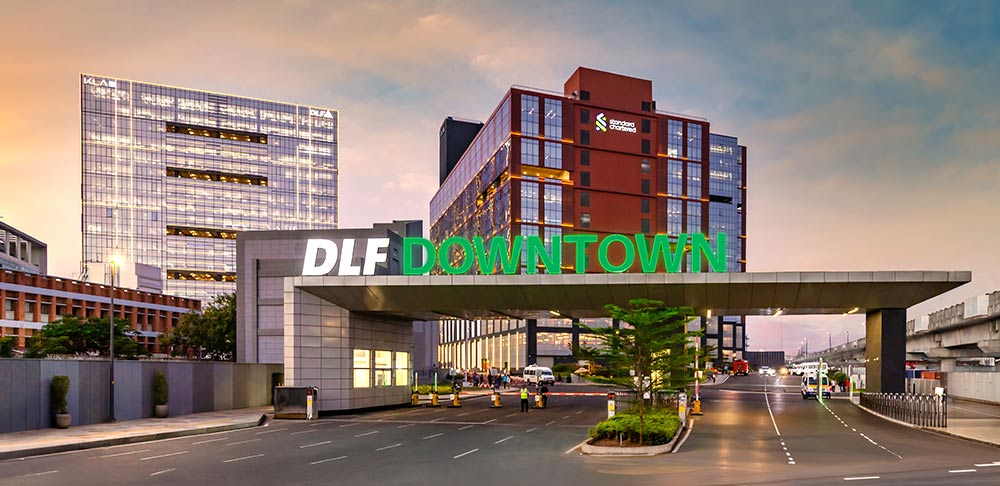
Chennai's technology sector clusters substantially around Tharamani and Manapakkam, where DLF Downtown Chennai and DLF Cyber City Chennai, respectively, provide large-format campus options within established IT corridors. Hyderabad's GCC ecosystem is concentrated around Gachibowli, where DLF Cyber City Hyderabad sits within one of India's most active technology clusters. In Gurugram, DLF Cyber City, DLF Cyberpark on NH-48, DLF Downtown Gurugram, and Atrium Place on NH-48 collectively address the range of requirements that technology occupiers bring to the NCR market. Location criteria that technology teams should assess:
- Proximity to the city's primary technology talent pool and the commute patterns that influence recruitment
- Metro or rail connectivity, since engineering talent in Indian cities is increasingly reliant on public transport
- Road infrastructure and the practicality of shuttle services from major residential catchments
- Proximity to peer organisations, since the informal talent market functions partly through professional networks that operate within geographic clusters
- Availability of support services, including food, banking, healthcare, and retail, within or immediately adjacent to the campus
Infrastructure and Digital Connectivity Requirements
This is where the gap between IT office space and conventional commercial office space becomes most concrete. A technology operation running continuous integration pipelines, video collaboration with global teams, real-time data processing, or cloud-dependent development workflows has connectivity requirements that a standard commercial building lease was not designed to meet.
WiredScore Platinum-certified buildings have been independently assessed against rigorous standards for internet connectivity, redundancy, resilience, and capacity. The certification matters because it replaces a developer's assurances with verified third-party evidence. For organisations whose India operations involve mission-critical data handling or real-time global collaboration, unverified connectivity claims carry real operational risk.
Power reliability is the infrastructure factor that gets underweight most consistently. A building with strong connectivity but unreliable power backup creates disruptions that compound across distributed teams. Enterprise-grade power systems, including uninterrupted power supply infrastructure and diesel generator backup at appropriate capacity, are non-negotiable for serious technology operations. Infrastructure factors to verify before committing to a lease:
- WiredScore Platinum certification confirming connectivity standards, redundancy, and capacity
- Multiple independent internet service provider connections with automatic failover capability
- Uninterrupted power supply systems with guaranteed uptime levels documented in the lease
- Adequate on-floor technical infrastructure: raised flooring, cable management, server room or data room provision
- Building management systems that provide real-time monitoring of power, cooling, and connectivity metrics
Access to Skilled Technology Talent
The building influences recruitment in ways that aren't always obvious at the point of signing a lease. Address matters in the technology talent market, partly because candidates use it as a proxy for the organisation's seriousness and partly because the commute calculation is real. An engineering team that spends 90 minutes each way in traffic is a team that is gradually making a different decision about where it wants to work.
Campus environments that offer a perceptibly better daily experience, visible investment in the physical workplace, quality food options, outdoor spaces, and a general sense that the organisation has chosen its environment deliberately, send a signal during recruitment that is difficult to replicate through employer branding alone.
For GCCs building senior technical leadership in India, the campus address is part of the proposition they make to candidates who have options. A LEED Platinum certified building with verified connectivity infrastructure, embedded wellness amenities, and a well-managed campus environment is a more credible setting for that conversation than a standard commercial floor.
Scalability and Expansion Flexibility
Growth in technology organisations tends to be uneven and hard to predict precisely. A team that is 300 people in January may be 600 by December if a product launch accelerates or a new GCC mandate arrives. The real estate implication of that growth needs to be absorbed without an operational disruption that lands at exactly the wrong time.
Campus-format IT parks in India, by design, accommodate this kind of expansion more naturally than standalone buildings. The ability to take adjacent floors or neighbouring blocks within the same address, without changing shuttle routes, security systems, cafeteria arrangements, or facility management contracts, is genuinely valuable. It is the kind of value that becomes visible only when growth happens faster than expected.
Managed IT office space offers a further layer of flexibility for organisations at an earlier stage or with less predictable growth curves, since lease terms and space configurations can be adjusted more readily than in traditional direct leases.
The Growing Demand for Plug-and-Play IT Offices
Not every technology team entering India, or expanding within India, wants to spend six months fitting out a shell-and-core floor. The demand for plug-and-play IT office space has grown substantially, particularly among mid-sized software companies, product organisations, and GCCs establishing their initial India presence.
The appeal is operational speed. A workspace that arrives with structured cabling, server room infrastructure, meeting room technology, high-capacity internet, and functional common areas removes an entire project management burden from a team whose attention needs to be elsewhere.
The quality of plug-and-play options in India's major tech corridors has improved considerably. What was once a choice between a bare lease and a generic coworking desk has expanded into a range of managed and semi-fitted configurations within purpose-built IT park environments.
Sustainability and Smart Building Features
The sustainability requirements for technology occupiers have a specific character. The engineering talent that GCCs and software companies compete for is a demographic that pays attention to environmental credentials, and organisations with public ESG commitments need their India real estate to contribute to, rather than undermine, those disclosures.
LEED-certified buildings, and LEED Platinum-certified campuses in particular, deliver both the environmental performance that ESG reporting requires and the operational quality that technology teams value in practice. MERV-14 air filtration, active indoor air quality monitoring, energy management systems, and water recycling infrastructure address both the sustainability reporting dimension and the daily environmental quality of the workspace.
The 5S framework, covering Sustainability, Safety, Social Infrastructure, Scale, and Space Solutions, captures the integrated approach that the best campus developers now bring to technology-sector occupiers. These dimensions are not separate considerations. They are interdependent features of a campus that function well for large, demanding technology operations over time.
Top Cities for IT Office Space in India
Each of India's primary technology markets has a distinct character that shapes what leasing in that city actually involves.
- Gurugram is the NCR's primary enterprise technology corridor, with a concentration of GCCs and multinational operations that have been built over decades. DLF Cyber City, DLF Cyberpark, DLF Downtown Gurugram, and Atrium Place collectively provide significant campus-format capacity across the city's technology belt.
- Hyderabad's HITEC City Gachibowli corridor, where DLF Cyber City operates, has become one of India's most active GCC markets.
- Chennai's established technology talent base makes it a consistent choice for software and IT operations; DLF Downtown Chennai in Tharamani and DLF Cyber City Chennai in Manapakkam address the southern city's campus-format demand.
- DLF Techpark Noida serves technology occupiers in the NCR looking at eastern corridor options, while DLF Techpark Chandigarh provides a northern India campus option with a distinct talent profile.
Key Factors to Evaluate Before Signing a Lease
The list of factors that matter is longer than most initial real estate briefs acknowledge. Technology teams that have worked through a poorly specified lease tend to add items that weren't on the original checklist. Factors that warrant rigorous assessment before commitment:
- WiredScore Platinum certification confirming verified connectivity standards
- Power backup specification, including UPS capacity and generator runtime, is documented in the lease
- Campus scalability: confirmed availability of adjacent space for phased headcount growth
- LEED certification level and whether it applies to the full building or only to the fitout
- Facility management quality and response time standards, particularly for HVAC, security, and technical systems
- Lease flexibility provisions: break clauses, expansion rights, and terms for taking additional space
- Transport connectivity, including shuttle availability, parking ratio, and proximity to metro infrastructure
- Campus amenity depth: food, healthcare, outdoor spaces, and retail that reduce off-campus dependency during the working day
Finding the Right IT Office Space for Long-Term Growth
The technology sector's relationship with office space is evolving, but the underlying requirements are becoming more specific, not less. The idea that distributed or hybrid work reduces the importance of the physical environment has proven only partially true. What it has actually done is raise the bar for what a physical campus needs to deliver in order to earn the commute.
For enterprises and GCCs, the right campus is one that performs on connectivity, holds up on sustainability, offers genuine scalability, and creates an environment that engineers find worth showing up for consistently. Buildings that satisfy the infrastructure checklist but neglect the human environment, or that invest in amenities without the underlying technical infrastructure, tend to underperform on both counts.
Explore IT office space in India with DLF Offices to find tech-ready workspaces built for the operational and human demands of serious software and technology organisations.
FAQs
Technology companies should prioritise WiredScore Platinum-certified connectivity, reliable power backup infrastructure, campus scalability for headcount growth, LEED certification, proximity to the city's technology talent pool, and lease flexibility provisions, including expansion rights and break clauses
Hyderabad, Gurugram, Chennai, Bengaluru, Pune, and Noida are the primary technology real estate markets. Hyderabad's Gachibowli and Gurugram's Cyber City corridor are among the most established for GCCs and large enterprise technology operations seeking campus-format space.
Plug-and-play IT office space is a pre-fitted workspace delivered with structured cabling, internet connectivity, meeting room technology, and operational infrastructure ready for immediate occupancy. It suits mid-sized software companies, product organisations, and GCCs establishing their initial India presence without the capacity to manage a fitout project.
WiredScore certification provides independently verified assurance of a building's internet connectivity standards, redundancy, and capacity. For technology operations dependent on continuous connectivity, unverified developer assurances carry operational risk. WiredScore Platinum is the highest tier and the relevant benchmark for enterprise technology occupiers.
Technology talent in Indian cities concentrates around specific micro-markets, and proximity to those clusters affects both recruitment success and commute times, which influence retention. A campus address within an established technology corridor also signals organisational credibility to candidates evaluating multiple opportunities.
