


-
 762
762 - Posted in August, 2026
LEED Certified Office Space in India: Why It Matters for Global Businesses
When a global company's India team moves into a new building, the checklist tends to look familiar: floor plate size, lease terms, parking ratios, proximity to talent. What gets examined less consistently, and what is becoming considerably harder to ignore, is whether the building itself will hold up under external scrutiny. Not just from regulators, but from the organisation's own sustainability team, its institutional investors, and the employees who will spend the majority of their working week inside it.
The conversation around green office buildings in India has matured considerably in the past few years. It is no longer an optional layer on top of a conventional real estate decision. For a growing number of global businesses, it has become the starting condition.
Why LEED-Certified Office Space Is Gaining Importance in India
The pressure hasn't come from one direction. Enterprise sustainability teams, global headquarters, and listing obligations have all converged on the same expectation: that the physical environments in which large organisations operate should be measurable, verifiable, and genuinely performing against environmental benchmarks, not just described as sustainable in a developer's brochure.
India's position as a preferred destination for global capability centres has accelerated this shift. GCCs operating from Indian cities are no longer peripheral outposts. They are strategic operations that appear in global reporting, contribute to enterprise headcount data, and increasingly, feature in the sustainability disclosures that listed companies submit to regulators and investors. The building address those GCCs occupy becomes part of the ESG story, whether the real estate team has thought about it that way or not. Factors pushing LEED-certified office space to the front of enterprise shortlists:
- Mandatory sustainability disclosure requirements from listed parent companies and institutional investors
- Internal ESG governance frameworks that evaluate real estate as a material environmental exposure
- Employee expectations, particularly among senior and specialist talent, around the quality of the workplace environment
- The measurability argument: LEED certification replaces vague sustainability claims with independently verified performance data
- Client and partner expectations in regulated industries where supply chain ESG credentials are actively assessed
What LEED Certification Means for Commercial Office Buildings
There is a version of this conversation that goes in circles because the term "green building" is almost entirely unregulated. Any developer can use it. LEED, by contrast, is a framework administered by the US Green Building Council and verified by independent assessors. It covers a building's performance across energy efficiency, water consumption, materials, indoor environment quality, and site considerations.
The certification operates across four tiers: Certified, Silver, Gold, and Platinum. The distinction between them is not cosmetic. A LEED Platinum certified building has been assessed against significantly more demanding criteria than a LEED Certified building and maintaining that status requires ongoing operational discipline rather than a one-time design achievement.
For enterprise occupiers evaluating options, the tier matters. LEED Platinum office space sits at the top of a performance range, and the gap between Platinum and uncertified buildings, in terms of energy consumption, indoor air quality, and water efficiency, is substantial enough to affect both operational costs and ESG reporting outcomes over a typical lease term. What the LEED framework actually assesses:
- Energy and atmosphere: consumption reduction, renewable energy integration, advanced metering capabilit
- Water efficiency: low-flow fixtures, recycling systems, rainwater harvesting, leak detection
- Indoor environmental quality: air quality standards, ventilation rates, occupant comfort controls, daylight access
- Materials and resources: construction waste management, responsible sourcing, building product transparency
- Sustainable sites and location: transport connectivity, habitat preservation, stormwater management
How LEED-Certified Offices Support Corporate ESG Goals
The relationship between the building and the ESG report is more direct than many real estate teams realise at the point of signing a lease. Scope 2 emissions, which cover the indirect greenhouse gas emissions from purchased energy, are directly influenced by the energy intensity of the office space an organisation occupies. A LEED Platinum building with renewable energy integration and active building management systems produces measurably lower scope 2 emissions per occupied square foot than a conventional commercial building.
That difference shows up in disclosures. It also shows up in internal reporting that leadership uses to assess progress against net-zero commitments. For enterprises that have made public climate commitments, the real estate portfolio is not a peripheral concern. It is one of the most visible and controllable contributors to the carbon data that stakeholders scrutinise.
The social dimension of ESG is also addressed. Buildings with MERV-14 air filtration, certified indoor air quality management, accessible design, and embedded wellness infrastructure are providing something measurable on the "S" axis of ESG: healthier, more inclusive environments for the people who work in them.
The Business Benefits of LEED Platinum Office Space
The sustainability case is clear. The business case is equally compelling, though it often gets less attention in initial leasing discussions.
Energy-efficient buildings cost less to operate. That relationship becomes material over a five or seven-year lease. HVAC systems designed for efficiency, LED lighting with intelligent controls, and building management platforms that respond to real-time occupancy data all reduce energy expenditure relative to older or less carefully designed buildings. The cost differential is not trivial.
There is also a risk management argument. As sustainability disclosure standards tighten, organisations whose real estate sits below credible environmental benchmarks face growing exposure: reputational risk in investor communications, compliance risk as regulation develops, and talent risk in markets where the quality of the workplace is an active factor in recruitment and retention. Business benefits that LEED-certified office buildings in India deliver:
- Reduced energy and utility costs through verified efficiency measures
- Lower scope 2 emissions that improve ESG disclosures and investor relations
- Reduced regulatory exposure as sustainability reporting obligations expand
- Enhanced talent attraction in competitive hiring markets where workplace quality is a differentiator
- Long-term asset value and lease stability associated with high-specification green buildings
Employee Wellbeing and Workplace Performance in Green Buildings
The indoor environment is where LEED certification translates most directly into daily experience. Most office workers spend the majority of their working hours inside a building without giving much thought to the quality of the air they're breathing, the temperature consistency across the floor, or the amount of natural light reaching their workstation. But these factors have been studied extensively, and the evidence on their effects is consistent.
MERV-14 air filtration captures a significantly higher proportion of fine particulates than standard commercial HVAC systems. In urban markets where outdoor air quality is a chronic concern, this is not a marginal gain. Buildings with active air quality monitoring, CO? management, and thermal comfort systems that respond to occupancy patterns create measurably different conditions than buildings without these specifications. The effects on cognitive performance, absenteeism, and reported workplace satisfaction are documented and meaningful.
Access to natural light and connection to outdoor spaces have their own evidence base. Biophilic design, the integration of natural elements into the built environment, is not an aesthetic preference but a response to research on stress, focus, and sustained wellbeing in workplace settings. Well-being features commonly verified in LEED Platinum office buildings:
- MERV-14 or higher air filtration with real-time indoor air quality monitoring
- CO? sensors and ventilation systems that adjust to real-time occupancy
- Verified natural light access across a meaningful proportion of the occupied floorplate
- Thermal comfort controls that allow individual or zone-level adjustment
- Outdoor spaces, green terraces, or landscaped areas integrated into the campus design
Why Global Businesses and GCCs Prefer LEED-Certified Office Space
The preference isn't arbitrary. It reflects a set of governance pressures that have become standard for organisations of a certain size operating across multiple jurisdictions. A GCC that starts with 400 employees and expands to 1,500 over three years needs a campus that meets international environmental standards throughout that journey, not just at the point of initial fitout.
Global headquarters that approve real estate decisions are asking questions about certifications with increasing regularity. The India real estate team that can demonstrate a LEED Platinum address, with WiredScore Platinum-certified connectivity infrastructure alongside it, is presenting a much stronger internal case than one offering a Grade A building without third-party verification of environmental performance.
The 5S framework, covering Sustainability, Safety, Social Infrastructure, Scale, and Space Solutions, reflects how the best campus developers now approach these projects. It acknowledges that global occupiers need every dimension to be addressed coherently, not just the environmental credentials in isolation.
Key Features to Look for in a LEED-Certified Office Building
Not all LEED-certified buildings perform equally within their certification tier. The assessment covers multiple categories, and a building can achieve certification while performing unevenly across them. Enterprise real estate teams should look beyond the certification plaque and verify the underlying performance data.
Features that differentiate genuinely high-performing LEED-certified buildings:
- Renewable energy integration: on-site solar generation or verified power purchase agreements, not just energy efficiency measures
- Sub-metering at the tenant level: the ability to access energy and water consumption data for individual reporting purposes
- WiredScore Platinum certification alongside LEED, confirming verified connectivity, resilience and redundancy
- Active sewage treatment and greywater recycling rather than municipal dependence for non-potable water uses
- Independently maintained air quality monitoring with accessible dashboards, not merely compliant HVAC specifications
- Fitout guidance and green lease provisions that allow tenant improvements without compromising the building's certification status
LEED Certification and the Future of Sustainable Office Space in India
The trajectory is upward. Voluntary certifications that were considered advanced practice five years ago are becoming baseline expectations for enterprise leasing in India's major commercial markets. The next wave of regulation, particularly around carbon reporting and building performance standards, will extend pressure that currently comes primarily from investor and internal governance frameworks into the statutory domain.
Buildings that achieved LEED Platinum certification in recent years and maintain it through ongoing operational management will be better positioned when that regulatory environment arrives. Those that were designed to certification standards without the operational discipline to maintain them will face a reckoning.
For enterprises signing leases today with terms of five years or longer, the forward-looking question is not just whether the building qualifies as green now but whether it will continue to qualify as standards rise.
Leading LEED-Certified Business Districts and Office Campuses in India
India's primary commercial markets have developed distinct clusters of high-specification, certified office space, and the quality of the leading developments in each city has risen considerably over the past decade.
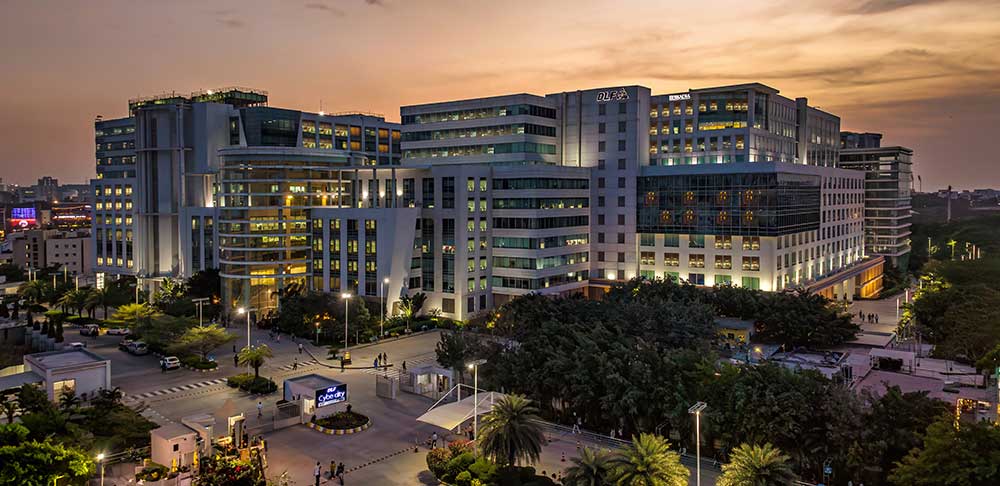
In Gurugram, DLF Cyber City remains one of the most recognised enterprise office addresses in the country, with a cluster of large-format LEED-certified buildings housing a significant proportion of the city's multinational occupier base. DLF Downtown Gurugram, DLF Cyberpark on NH-48, and Atrium Place on NH-48 extend this footprint across the city with campus environments built to comparable sustainability standards.
DLF Cyber City Hyderabad in Gachibowli serves one of India's fastest-growing GCC ecosystems with campus-format, certified space. In Chennai, DLF Downtown Chennai in Tharamani and DLF Cyber City Chennai in Manapakkam address the southern market's considerable enterprise demand within developments that operate to LEED standards. DLF Techpark Noida and DLF Techpark Chandigarh provide certified campus options in northern markets for enterprises exploring locations beyond the primary metro corridors.
Choosing the Right LEED-Certified Office Space for Long-Term Growth
The certification is the starting point, not the endpoint. Once a building clears the LEED threshold, the decision criteria narrow to questions about operational performance, campus scalability, and the developer's track record in maintaining standards over time.
An enterprise committing to a long-term lease in a certified building should assess whether the developer actively manages the asset to maintain its certification, whether the campus can absorb headcount growth without forcing a relocation, and whether the developer's approach to sustainability is embedded in their operating model rather than applied at the design stage and then left.
Making Sustainability a Strategic Real Estate Decision
The organisations that treat green certification as a tick-box exercise tend to face the same problem eventually: they have a certificate but not a performance story. The distinction matters because stakeholders, whether investors, employees, or regulatory bodies, are increasingly equipped to tell the difference.
Choosing LEED certified office space in India that is actively maintained to Platinum standards, integrated with verified connectivity infrastructure, and operated by a developer with genuine long-term sustainability commitments is a real estate decision that holds up to scrutiny over a five or ten-year horizon. That durability is increasingly the standard global businesses should be applying when they evaluate their options.
Find LEED-certified office environments with DLF Offices to understand what a verified, high-performance, sustainable workspace looks like at a campus scale across India's major commercial markets.
FAQS
LEED certified office space in India refers to commercial buildings independently assessed and verified against the Leadership in Energy and Environmental Design framework, covering energy efficiency, water conservation, indoor air quality, and materials. LEED Platinum represents the highest certification tier.
The certification tier reflects actual performance levels. A LEED Platinum certified building meets significantly more demanding criteria than a LEED Certified building, with measurable differences in energy consumption, indoor air quality, and water efficiency that directly affect ESG reporting and operational costs.
LEED-certified buildings reduce scope 2 emissions, satisfy ESG disclosure requirements, and provide independently verified sustainability credentials that global headquarters and institutional investors increasingly expect. For GCCs, certified campuses demonstrate that India operations meet international environmental governance standards.
LEED operates across four tiers: Certified, Silver, Gold, and Platinum. LEED Platinum is the highest tier, requiring the greatest point score across all assessment categories. The performance gap between Platinum and lower tiers is substantial in terms of energy efficiency, water management, and indoor environmental quality.
Yes. LEED Platinum buildings typically incorporate MERV-14 air filtration, active indoor air quality monitoring, thermal comfort controls, and natural light access, all of which have documented associations with improved cognitive performance, lower absenteeism, and higher employee satisfaction in workplace research.
