


-
 118
- Posted in October, 2026
Office Space for GCCs in Chennai: A 10-Point Enterprise Selection Checklist
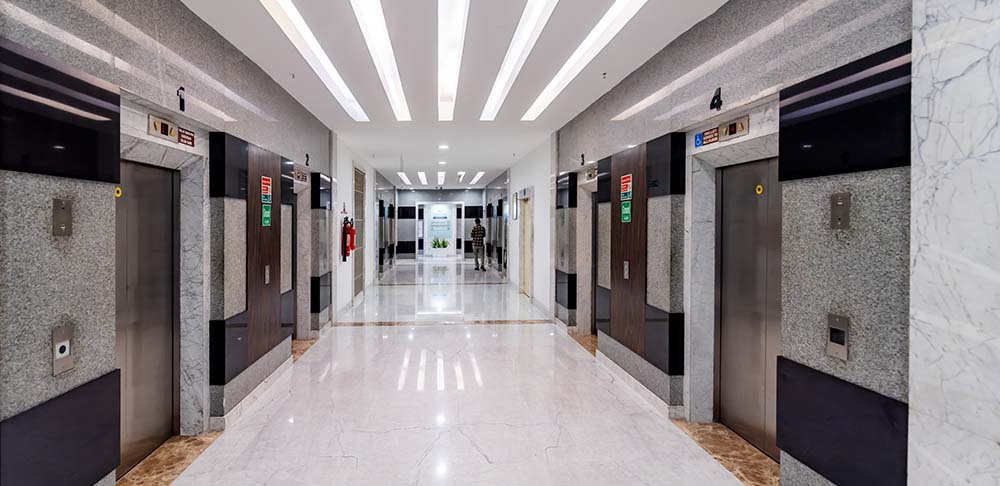
Most enterprises evaluating Office Space for GCC in Chennai use incomplete assessment frameworks. They evaluate buildings and locations separately rather than assessing how buildings and locations combine to enable GCC operations. They prioritise individual specs (floor height, power backup, rent per square foot) without understanding how those specs interact to affect organisational performance over a five-to-seven-year lease term. They make location decisions without accounting for how location shapes recruitment, retention, operational efficiency, and long-term growth trajectory.
The result is predictable: enterprises sign leases confident in their evaluation, then spend months or years managing the operational friction that the incomplete assessment missed. By that point, the lease is signed, and alternatives are financially impossible.
A structured evaluation framework prevents this outcome. A comprehensive 10-point assessment addresses the dimensions that actually determine whether an Office Space for Lease in Chennai enables GCC success or constrains it.
The GCC Evaluation Problem
GCCs operate differently than conventional enterprise offices. They require 24x7 infrastructure reliability. They scale rapidly (500 to 2,000 people over three to five years). They attract and compete for technical talent continuously. They host clients and support complex operations. The evaluation criteria that matter for a standard office do not fully address GCC requirements.
Standard evaluation focuses on rent, building specs, and location visibility. GCC evaluation requires assessing scalability, infrastructure resilience, talent ecosystem access, operational support systems, and cost-performance alignment across a multi-year lifecycle.
The 10-Point Evaluation Checklist for GCC Office Space
Enterprises evaluating Grade A+ Office Space Chennai should use this structured assessment addressing the dimensions that determine GCC success:
- Scalability and Campus Capacity: Does the property provide expansion options without relocation? Can a 500-person launch scale to 1,500 or 2,000 people across towers within the same campus? Are adjacent spaces contractually available? Single-building properties fail this assessment. Integrated campuses with multiple towers pass. DLF Downtown Taramani Chennai (Phase I 3.4 MSF, Phase II 3.6 MSF) enables 500-to-2,000-person scaling within campus boundaries.
- Commute Accessibility and Talent Geography: Is the location within a reasonable commute distance from technical talent residential clusters? Can employees access it via metro or established transit? Do 60-70% of Chennai's technical talent live within a 30-minute commute? Locations requiring 60-minute commutes for most talent fail. Taramani positioning within the OMR corridor near three major talent clusters passes.
- Infrastructure Redundancy and 24x7 Operations: Does the building provide 100% backup power capacity? Are HVAC systems capable of continuous operation? Is building management monitored 24x7? Does the property carry third-party certifications (LEED Platinum, WiredScore Platinum) verifying infrastructure performance? Properties lacking full redundancy or without 24x7 management fail. Grade A campuses with documented infrastructure pass.
- Digital Connectivity and Fibre Capacity: Does the property have high-capacity fibre infrastructure? Is building-wide Wi-Fi redundant? Are bandwidth provisions adequate for 24x7 GCC operations and client infrastructure hosting? WiredScore Platinum certification verifies digital infrastructure quality. Properties without high-capacity fibre or WiredScore certification fail this assessment.
- Sustainability and ESG Compliance: Does the property carry LEED Platinum certification or equivalent? Are energy, water, and waste performance documented? Can the building support corporate ESG reporting requirements? Properties without verifiable sustainability certifications limit enterprise ESG capability. LEED Platinum and planned LEED Zero certifications (DLF Downtown Taramani) enable full ESG compliance.
- Building Safety and Compliance: Does the property carry the British Safety Council Sword of Honour or equivalent safety certifications? Are security protocols multinational standard (access control, surveillance, trained operations)? Are emergency management procedures documented? Compliance with multinational safety standards is non-negotiable for GCC operations.
- Amenity Ecosystem and Employee Support: Are on-campus amenities available (food, fitness, medical, business services)? Do amenities support 24x7 operations at GCC scale? Is the amenity ecosystem integrated into campus planning or a bolted-on afterthought? Adequate amenities reduce daily workplace friction and improve retention. Sparse or external-only amenities create dissatisfaction.
- Cost Structure and Total Occupancy Economics: What is the total cost of occupation (headline rent plus maintenance plus parking plus fit-out plus escalations) across the lease term? Are maintenance charges capped or escalating? Do escalation clauses run 5% or 15%? Cost-first evaluation fails this assessment. Multi-dimensional cost modelling (including operational benefits from infrastructure quality) passes.
- Location Ecosystem and Service Proximity: Is the property positioned within an ecosystem of technology companies, service providers, and specialised vendors? Can the GCC access consultants, recruitment partners, compliance expertise, and training providers without leaving the campus area? Isolated properties fail. Taramani's positioning within the OMR corridor ecosystem, with hundreds of technology companies, passes.
- Lease Flexibility and Long-Term Adaptation: Does the lease include renewal rights without full renegotiation? Are expansion options contractually secured? What happens if headcount decreases materially? Are exit provisions enabling subletting or assignment if circumstances change? Leases lacking flexibility limit enterprise adaptation capability. Structured leases with renewal, expansion, and exit options enable long-term management flexibility.
Applying the Checklist to Chennai Options
Evaluating Ready to Move Office Space Chennai using this 10-point framework reveals significant variation in how properties address GCC requirements.
- Single-building properties fail on Scalability and Location Ecosystem Access. Limited expansion options force mid-lease relocation. Isolation from service providers and technology vendors increases operational costs.
- Peripheral tech parks fail on Commute Accessibility and Location Ecosystem Access. Poor proximity to technical talent residential clusters creates recruitment challenges. Lack of ecosystem support limits service delivery capability.
- Ageing commercial stock fails on Infrastructure Redundancy, Digital Connectivity, Sustainability, and Building Safety. Infrastructure standards are unverified. No third-party certifications. Safety compliance unclear.
- Integrated campuses in accessible locations address all dimensions comprehensively. Scalability accommodates growth. Commute Accessibility attracts talent. Infrastructure and Digital Connectivity meet enterprise standards. Sustainability certifications support ESG reporting. Building Safety meets multinational compliance. Amenity Ecosystem supports operations. Cost Structure remains competitive. Location Ecosystem provides service access. Lease Flexibility enables adaptation.
DLF Downtown Taramani Chennai specifically addresses all 10 dimensions: campus expansion across Phase I and II, Taramani proximity to talent clusters, 100% backup power, LEED Platinum plus WiredScore Platinum, safety certifications, 200,000 square feet amenities, competitive occupancy cost with infrastructure quality, OMR ecosystem access, and flexible lease options.
Why the 10-Point Framework Prevents Costly Decisions
The checklist forces structured evaluation rather than cherry-picking appealing attributes. A building might appear attractive on headline rent but fail on Scalability, forcing expensive relocation when headcount grows. A location might seem accessible but fail on Location Ecosystem, limiting service delivery and operational efficiency. A building might provide backup power but lack Sustainability Certifications, limiting corporate ESG support.
Comprehensive assessment reveals these trade-offs explicitly. An enterprise can then decide whether compromises are acceptable or whether the location needs to address all dimensions.
From Evaluation to Decision
Using the structured checklist, enterprises identify properties or campuses addressing their specific requirements. No property perfectly addresses all 10 dimensions (trade-offs always exist). But properties addressing 8-to-10 dimensions provide confidence that the location enables GCC success across a lease term.
Commercial Office Space Chennai options vary substantially. Systematic evaluation distinguishes properties that enable GCC operations from those that merely provide space. Properties scoring 6 or lower fail to meet comprehensive GCC requirements. Properties scoring 8 or higher provide a strategic foundation.
Implementing Disciplined Evaluation
The discipline of structured evaluation prevents the common mistake of signing leases prematurely. Enterprises should:
- Complete the 10-point assessment across all short-listed properties
- Score each property on each dimension (1-10 scale)
- Identify which points are non-negotiable for GCC operations
- Evaluate trade-offs explicitly
- Model total cost and long-term implications
- Negotiate lease terms explicitly addressing points 7 through 10
This discipline converts subjective evaluation into structured assessment. Subjective assessment leads to regret. Structured assessment leads to informed decisions aligned with GCC requirements.
Strategic Location Selection Through Systematic Assessment
Office Space for GCC in Chennai using the 10-point framework becomes a strategic decision rather than a cost-minimisation exercise. Enterprises recognise that location shapes whether a GCC thrives or merely functions. The evaluation framework ensures location decisions optimise GCC success rather than optimising rent savings.
Enterprises that apply structured evaluation to office space selection consistently make better decisions. They avoid locations that appear attractive on one or two dimensions but fail when assessed comprehensively. They identify locations that genuinely enable GCC operations across multiple dimensions.
Evaluate DLF Downtown Taramani Chennai using this 10-point framework. Assess how the property addresses scalability, accessibility, infrastructure, sustainability, safety, amenities, cost structure, ecosystem, and lease flexibility. The comprehensive evaluation will reveal why the location is strategically positioned for GCC operations in Chennai.
FAQs
GCCs grow 500 to 1,800 people over five years. Relocation costs run 15-25 million rupees and disrupt operations 3-6 months. Campus expansion avoids this cost entirely.
Inaccessible locations require 15-25% compensation premiums over five years. For 500-person GCC, costs exceed 50-75 million rupees. Accessible locations avoid this premium.
No. Cost-first decisions create operational disruptions, retention loss, and ESG compliance gaps that offset rent savings within 18-24 months.
Calculate total cost (rent plus maintenance plus parking plus fit-out plus escalations). A 10% rent discount offset by 15% higher maintenance and 10% escalations costs more than competitive alternatives.
No. Most scoring below 8 fail on Scalability, Infrastructure, or Ecosystem. Failures force costly relocation, create disruptions, or increase service costs beyond any rent savings.
