


-
 580
580 - Posted in September, 2026
Office Space in Hyderabad: Leasing Guide for GCCs and Tech Companies
Hyderabad did not become one of India's most sought-after GCC destinations through marketing. It earned the position through a sustained combination of policy stability, infrastructure investment, and a talent pipeline that has continued to deepen even as competing cities have experienced the attrition and cost pressures that come with rapid growth. What is interesting about the city's current position is that the demand has not plateaued. If anything, the profile of businesses seeking office space in Hyderabad has become more sophisticated, and the expectations they bring have pushed the commercial real estate market to a standard that was not uniformly achievable here even five years ago.
What drives that evolution, and where within the city does it actually matter for a leasing decision? Those are the questions worth working through carefully.
Why Hyderabad Is a Leading Destination for GCCs and Tech Firms
The short answer is that Hyderabad figured out how to compete on more than cost, earlier than most Indian cities did. The Telangana government's consistent posture toward technology and enterprise investment created a regulatory environment where businesses could make medium-term commitments with reasonable confidence. That predictability is rarer than it sounds and matters considerably to organisations making a five-year office commitment from a boardroom in the US, UK, or Germany.
The talent dimension is equally important. Hyderabad's universities and technical institutions have maintained strong graduate output across engineering and technology disciplines. The city's professional workforce is experienced, English-proficient, and increasingly familiar with the operating expectations of multinational organisations. Critically, Hyderabad has not yet reached the saturation point where lateral hiring becomes a zero-sum competition with every other major employer in the city. What positions Hyderabad distinctly as a GCC and tech destination:
- Government consistency in supporting IT and enterprise investment without frequent policy reversals
- A large and growing pool of engineering and technology talent across experience levels
- Commercial office supply that has scaled alongside demand without generating the oversupply distortions seen in some markets
- International airport connectivity that supports management teams moving frequently between Hyderabad and the headquarters
- A cost environment that remains competitive without the aggressive cost-cutting that can signal a secondary market
The Growth of Hyderabad's Commercial Office Market
Hyderabad's commercial office market has undergone a qualitative shift in the past decade, not just a quantitative one. The volume of space leased has grown, but more significant is the change in what the market now offers at its upper end.
The city's evolution from a market characterised by standard IT parks to one with campus-scale, LEED-certified, institutionally developed buildings has made it a credible alternative to Bangalore for global occupiers with genuinely high infrastructure expectations. That comparison would not have been made comfortably a decade ago. It is made routinely now. Several factors explain this trajectory:
- Large-scale global occupiers entering the market and pulling building standards upward through their own specification requirements
- Developer investment in Grade A buildings that meet international certification benchmarks
- The GCC wave bringing not just volume but operational sophistication that demands corresponding workplace quality
- Infrastructure improvements around key commercial corridors, particularly in the western part of the city, that have made large-format developments viable
Why Gachibowli Hyderabad Continues to Attract Global Occupiers
Gachibowli has become almost synonymous with Hyderabad's enterprise office market, and that association is earned rather than simply received. The corridor developed in alignment with the city's IT sector growth and accumulated the supporting infrastructure, transport links, hospitality, retail, and professional services, that transforms a commercial zone into a functioning business district.
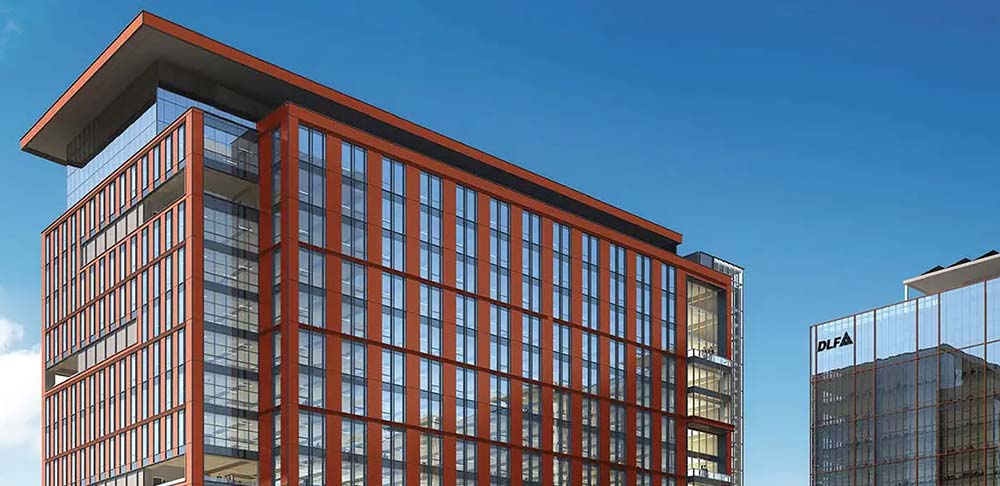
DLF Cyber City Hyderabad in Gachibowli sits at the centre of this ecosystem. The development serves the GCC and tech occupier profile that defines the area's demand, offering institutional-quality space within a location that has the built environment around it to support large workforces on a daily basis. For businesses recruiting talent from the residential zones of Kondapur, Madhapur, Nanakramguda, and the broader Hitec City belt, Gachibowli's position within that geography matters practically rather than just symbolically.
The concentration of multinational occupiers in Gachibowli also has a compounding effect. Senior professionals with options will evaluate an employer's office location against the alternatives available to them. A credible address in the right part of the city signals organisational seriousness in ways that a cheaper location in a less developed corridor does not, regardless of what the internal workspace looks like.
Beyond Gachibowli: Understanding the Broader Western Corridor
The western corridor of Hyderabad, stretching from Hitec City through Gachibowli and into the Financial District, has become a coherent commercial geography with distinct micro-market characteristics. Occupiers evaluating office space for lease in Hyderabad should understand the commute dynamics within this corridor, as the residential zones feeding different parts of it vary, and aligning the office location to where target employees actually live affects daily attendance in ways that accumulate over time.
Access to Talent and Innovation Ecosystems
Talent access in Hyderabad has a specific character that GCC and tech decision-makers should understand rather than assume. The city's graduate pipeline is strong across engineering disciplines, but the senior talent profile, professionals with ten to twenty years of relevant experience in technology or finance, has a geography that clusters around the western corridor more than any other part of the city.
This concentration is not coincidental. It reflects decades of employer activity in Gachibowli and the surrounding areas, which drew experienced professionals to live nearby. For a GCC setting up operations and needing to hire delivery leads, architects, and senior analysts quickly, the proximity of experienced talent to the office location shortens recruitment timelines meaningfully.
What enterprise and tech occupiers should assess when evaluating talent access:
- Proximity of the office location to the residential zones where target hire profiles are concentrated
- Presence of peer enterprises in the micro-market, which creates a lateral hiring pool and supports organic referral recruitment
- Metro and road connectivity from the building for employees commuting from different residential zones
- The building's amenities and workplace quality, which form part of the employer value proposition in a competitive talent market
What GCCs Need from Modern Office Space
The requirements of a GCC operation are specific in ways that generic commercial office specifications do not always capture. A GCC is not simply a large team in a building. It is a strategic function of a global organisation, and the physical environment in which it operates needs to reflect that status.
Floor plate size is one dimension. GCC operations frequently require large, contiguous working areas that support team adjacencies, collaboration zones, and the physical configuration of cross-functional delivery. Buildings with small or fragmented floor plates create operational friction that is felt daily.
Beyond Configuration, GCC Occupiers Need:
- LEED Platinum certified buildings that support parent company ESG reporting requirements
- MERV-14 air filtration as a documented indoor air quality standard, relevant for large teams and globally benchmarked workplace wellness policies
- WiredScore Platinum connectivity certification, confirming that the building's digital infrastructure can sustain the constant, high-bandwidth connectivity that GCC operations depend on
- Campus-scale amenities that support a workforce spending full working days on site, including food, fitness, and breakout infrastructure
- Scalability within the development to accommodate headcount growth without relocation
Buildings developed under the ‘5S’ framework, addressing Sustainability, Safety, Social Infrastructure, Scale, and Space Solutions, address this profile as an integrated system rather than as a checklist. The result is a workplace that functions coherently rather than one where individual specifications are strong but the overall environment is uneven.
Grade A Offices and Enterprise-Ready Infrastructure
Grade A designation in the Hyderabad market covers a significant variation. For tech companies and GCC operations with global reporting obligations or internationally experienced workforces, the label alone is insufficient guidance.
The certifications that provide independent verification of building quality are well established. LEED Platinum certification covers energy performance, water management, indoor environmental quality, and materials, each audited against documented benchmarks. WiredScore Platinum certification independently evaluates digital connectivity, covering redundancy, capacity, and in-building wireless quality.
For enterprise and tech occupiers entering the Hyderabad market from international bases, these certifications provide the translation layer that makes Indian commercial space comparable to what they evaluate in other markets. A building with documented LEED Platinum and WiredScore Platinum credentials can be benchmarked against equivalents in Singapore, London, or Chicago using shared reference points. That comparability matters when building decisions are being reviewed by international real estate and compliance teams.
Managed, Furnished and Traditional Office Options
The format decision for commercial office space in Hyderabad deserves the same rigour as the location decision, particularly for GCC and tech companies at different stages of their India journey.
Traditional leases in Hyderabad's Grade A market typically run three to five years with lock-in periods, security deposits of six to ten months of rent, and rent escalation clauses of around 15% every three years. The economic logic is strongest at scale and over a stable operational horizon. The challenge for businesses entering Hyderabad for the first time is the upfront fit-out capital requirement and the need for local management during setup.
Furnished and managed office space in Hyderabad serves a distinct set of circumstances:
- Early-stage India entry where headcount trajectory is not yet confirmed
- Rapid deployment requirements where a team needs to be operational within weeks
- Satellite operations of a size that does not justify the overhead of a full direct lease
- Interim space during the period between lease expiry and a new space becoming ready
Many tech companies and GCCs begin in managed space within a Grade A development and transition to a conventional lease within the same building or corridor as operations stabilise. That approach preserves address continuity, which matters for both employer branding and client confidence during the growth phase.
Scalability for Fast-Growing Tech Teams
Few decisions affect the long-term cost of an India office operation more than getting scalability wrong at the outset. A tech team or GCC that grows faster than the building can accommodate faces a relocation, which carries costs in rental duplication, fit-out write-offs, employee disruption, and operational continuity that are frequently underestimated when the original lease is being evaluated.
Before committing to any office space in Hyderabad, enterprise occupiers should establish:
- Total developable or leasable area within the project beyond the initially committed space
- Whether expansion rights or right-of-first-refusal clauses on adjacent floors can be built into the initial lease
- Whether the developer has a track record of accommodating growing tenants within the same development
- How the floor plate configuration supports future team arrangements without constant reconfiguration
DLF Cyber City Hyderabad in Gachibowli is designed at a scale that serves this growth trajectory. The development accommodates occupiers at entry scale and can support substantial expansion within the same address, removing the operational disruption that repeated relocations create during periods of organisational growth.
Sustainability and ESG Considerations
ESG has moved from corporate commitment to operational requirement in the context of Indian office space for global organisations. Parent companies with listed equity, institutional investors, or regulatory disclosure obligations in Europe or North America now routinely include the real estate portfolio in their sustainability reporting scope. The India office is included in that scope whether the local team is aware of it or not.
LEED Platinum certified buildings provide the documented performance data that feeds into global reporting frameworks. Energy consumption benchmarks, water efficiency metrics, and indoor air quality standards including MERV-14 filtration are all audited outcomes of LEED Platinum certification. For occupiers managing scope 3 emissions reporting or responding to investor ESG questionnaires, a LEED Platinum address provides audit-ready documentation rather than approximated estimates.
The practical implication for tech companies and GCCs choosing office space in Hyderabad: building sustainability credentials are increasingly a leasing criterion rather than a preference. Selecting a building without documented certification can create a reporting gap that becomes increasingly difficult to explain to global stakeholders over the lease term.
Selecting the Right Office Space in Hyderabad for Long-Term Growth
Hyderabad's commercial office market in 2026 is one that rewards careful evaluation rather than simply defaulting to the most prominent address. The city has enough quality supply in the right locations that an enterprise occupier with clear specification criteria and a sound understanding of the leasing mechanics can find space that performs well over the full lease term.
What makes Hyderabad interesting at this moment is that it is still in a phase of quality improvement. The ceiling has risen considerably, but the market has not yet reached the point where quality is uniform across all Grade A buildings. That gap between the best and the rest is where the leasing decision genuinely matters. The businesses that distinguish LEED Platinum from Grade A, WiredScore Platinum from "good connectivity," and campus scale from floor count will make a different decision than those that do not.
Explore DLF office spaces in Hyderabad at DLF Cyber City in Gachibowli, with the institutional-quality infrastructure, certified building standards, and development scale that GCC and enterprise tech occupiers require.
FAQs
Gachibowli combines the highest concentration of multinational tech and GCC occupiers in Hyderabad with strong road and metro connectivity, a mature supporting ecosystem of hospitality and services, and proximity to the residential zones where most senior tech professionals in the city live.
LEED Platinum certification for sustainable building performance including MERV-14 air filtration, and WiredScore Platinum certification for digital connectivity infrastructure. Both are independently verified and allow meaningful comparison with international Grade A standards, which matters for global real estate and compliance teams.
Hyderabad offers comparable talent quality with a cost base that remains competitive relative to Bangalore, and a government environment that has been more consistently supportive of enterprise investment. Bangalore has greater talent density at the senior level, but Hyderabad's attrition rates and cost stability make it a compelling alternative for GCC setups prioritising operational continuity.
Managed offices work well for GCC operations at early stages, particularly where headcount certainty is limited or rapid deployment is required. Most GCCs transition to conventional leases as the operation stabilises, ideally within the same building or development to preserve address continuity and avoid employer brand disruption.
Standard Grade A commercial leases in Hyderabad run three to five years with a lock-in period. Security deposits are typically equivalent to six to ten months of rent and are negotiated. Rent escalation of approximately 15% every three years is standard across the Grade A market.
